What Is Nylon Fiber?
From sheer hosiery to climbing ropes, nylon has been used wherever strength, stretch, and recovery need to work together. It was the first synthetic fiber and the first fiber developed in the United States. In 1928, the DuPont Company started a basic research program as part of its effort to diversify, and it hired Dr. Wallace H. Carothers, an expert on high polymers, to lead the team. The group built long molecular chains and found that one solution could be formed into a stable solid filament, which shifted their focus toward textile fibers. By 1939, DuPont was making polyamide fiber in a pilot plant, and nylon 6,6 was introduced in women’s hosiery with immediate success.
Nylon had a combination of properties unlike any other fiber in use in the 1940s. It was stronger, more abrasion resistant, highly elastic, and could be heat-set. Permanent pleats became possible, and durable, machine-washable sheer fabrics were available for the first time. At the same time, nylon also had drawbacks such as static buildup, poor hand, limited comfort in skin-contact fabrics, and low resistance to sunlight. Its two main commercial forms are nylon 66 and nylon 6, which are isomers and therefore differ in structure and some fiber properties.
Historical Background
The generic name nylon was proposed in 1938 by DuPont, the company that produced the first commercially made fibers that year. Before settling on nylon, the company had considered Delawear, for the state in which the DuPont laboratories were located. It also considered Duparooh, for “DuPont pulls a rabbit out of a hat” (Meikle and Spivak 1988). Although the processes for making both nylon 66 and nylon 6 had been known since the earliest experimentation on nylon, DuPont, which pioneered nylon development in the United States, chose to use the nylon 66 process.
Nylon production has grown in volume over the past several decades, but its share of the synthetic fiber market has declined as polyester and olefin have grown significantly. Some of the chemical companies that were prominent in the development of nylon and other synthetics no longer produce fibers. DuPont Chemical Company spun off its commodity fibers division into a separate company, INVISTA. Honeywell, which had acquired nylon producer Allied Signal, sold its American fiber business to Shaw Industries, a carpet manufacturer, thus integrating the fiber and fabric components of the supply chain. DuPont and Honeywell do, however, continue to manufacture the chemicals used to make the nylon polymers. Nylon was for many years the second most widely used synthetic fiber, but it has now been overtaken by olefin fibers.
Manufacture of Nylon
The chemistry is straightforward, but the processing steps matter.
Nylon 66
Nylon 66 is synthesized from adipic acid and hexamethylene diamine. There are six carbon atoms in each molecule of adipic acid and six in each molecule of hexamethylene diamine. For that reason, the fiber is designated nylon 66, sometimes written as nylon 6,6.
The first step in nylon 66 manufacture is preparation of a nylon “salt,” which is a compound, but not a polymer, of adipic acid and hexamethylene diamine. The salt is prepared first to ensure the proper ratio of acid and amine in the subsequent polymerization step. This condensation polymerization takes place in an air-free atmosphere. The water split off during polymerization is allowed to escape from the reacting tank. If the manufacturer wants to produce a delustered nylon, titanium dioxide can be added during this step. In earlier processes, the molten polymer that formed was extruded from the tank as a ribbon several inches wide. It was quenched in cold water and then broken into smaller nylon chips. A continuous process is more common today, with the nylon synthesized and then extruded directly as fibers.
Nylon 6
Nylon 6 is made from caprolactam. Because caprolactam has six carbons, the fiber is known as nylon 6. Variants of the nylon 6 structure, nylon 7 and nylon 11, are produced in Russia but are used in films, not fibers.
Caprolactam is polymerized by one of two methods. In one, it is melted, heated, and filtered under high pressure, during which condensation polymerization takes place. In the second, water equal to 10 percent of the weight of the caprolactam is added. The water and caprolactam are then heated to a high temperature, steam escapes, and polymerization takes place.
Spinning and drawing
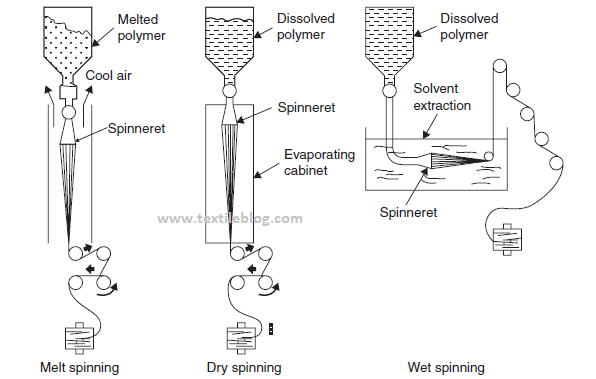
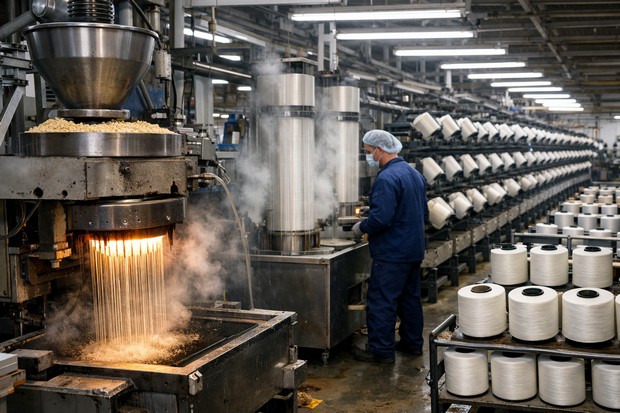
Both nylon 66 and nylon 6 are melt spun. The melted polymer is delivered from an extruder or directly from a polymerizer and passes through a filter to remove impurities. It is fed to a metering pump that delivers a measured amount of polymer to the pack, which consists of a small filter and spinneret. As they exit the spinneret, the molten filaments enter a chimney where they are air-cooled and simultaneously stretched to orient the molecules. Spin finish, a complex mixture of oil lubricants emulsified in water together with materials such as wetting agents, antistatic agents, and adhesives, is coated onto the fiber. The finish lubricates the fibers for later processing and disperses static electrical charges that would interfere with yarn formation. It is eventually washed from the fabric.
After the finish is added, the fiber is wound onto a bobbin. In this state, nylon is not especially strong or lustrous, so the fibers are stretched to 400 to 600 percent of their original length. The stretching orients the molecules, makes the fiber more crystalline, increases luster, and improves tensile strength. Because nylon has a low glass transition temperature, little heat is required to orient the molecules during this step, and nylon fibers are said to be cold drawn.
Molecular structure after drawing
The polyamide chains in drawn nylon are fairly highly oriented in a crystalline structure. When the molecules are straightened during the drawing process, they have no bulky side groups to prevent them from packing closely together. Crystalline areas form easily, and hydrogen bonds form between the amide links of adjacent polymers. The fibers are 50 to 80 percent crystalline, depending on the amount of drawing. In the amorphous areas, the polymers are coiled, allowing the fiber to stretch and recover. Nylon 66 and nylon 6 differ in chain packing because of differences in the order of groups in the amide linkages.
Properties of Nylon
Physical Properties
Appearance
Normal nylon, in microscopic appearance, looks like a long, smooth cylinder. Its cross section is circular, and it is naturally lustrous unless it is delustered. The cross-sectional shape of nylon 66 or nylon 6 can be varied to produce fibers with a particularly desirable appearance or performance quality. For example, nylon 66 is sometimes made in trilobal or multilobal forms. The trilobal shape, similar to that of silk, reflects more light, thereby increasing luster, and the smaller effective cross section allows the fiber to bend more easily, providing better fabric drape.
Specific Gravity
Nylon is a relatively low-density fiber, with a specific gravity of 1.14, which is lower than most other fibers. In comparison, the specific gravity of rayon is 1.5 and that of polyester is 1.38. Nylon can be made into very light, sheer fabrics of good strength.
Mechanical Properties
Strength
The strength of nylon is excellent, and it can be produced in a variety of tenacities depending on the intended end use. The regular tenacity of nylon 66 is 3 to 6 g/d; that of regular nylon 6 is 4 to 7 g/d. High-tenacity nylon 66 that has been drawn more during spinning can range from 6.0 to 9.5 g/d. The exceptional strength of nylon has led to its use in a variety of industrial items, such as seat belts and soft-sided luggage. It also predominates in the field of women’s hosiery. Because the fibers are so strong, they can be made in the very fine deniers required for sheer hosiery and lingerie.
Modulus
Even though nylon is a strong fiber, it has a low modulus, so it stretches easily with little force. This is in contrast to polyester, which has a higher modulus. Although nylons are generally strong compared to many other fibers, their use in some industrial products such as geotextiles and sailcloth is limited by their low modulus. On the other hand, this is a plus for sweaters, swimwear, and activewear, where low resistance to stretch provides comfort and fit.
Elongation and Recovery
Nylon exhibits fairly high elongation before breaking, but when extended short of the breaking point, it will recover well. This helps garments made of nylon, or nylon blended with elastic fibers such as spandex, retain their shape and dimensions.
Resilience
Not only does nylon recover well from stretching, it also has excellent recovery from compression. This feature makes it ideal for carpets and rugs. Nylon is also wrinkle resistant and was used in some of the first “drip dry” garments. Elastic recovery of nylon 6 is claimed to be slightly better than that of nylon 66.
Flexibility
Nylon has low resistance to bending and can be flexed easily. Nylon fabrics are usually fairly drapable depending on their weight and construction.
Chemical Properties
Absorbency and Moisture Regain
Nylon is moderately hydrophilic, having better moisture regain than many manufactured fibers. Nevertheless, nylon fabrics dry quickly after laundering.
Heat and Electrical Conductivity
Nylon is a poor conductor of electricity and builds up static electricity, especially when humidity is low. It is a good insulator in electrical materials because of its nonconducting qualities. Special nylons have been manufactured to improve conductivity and decrease static electricity. Nylon’s heat conductivity is also low.
Effect of Heat; Combustibility
The melting point of nylon 66 is about 500°F. It will soften and may start to stick at 445°F. Nylon 6 is even more heat sensitive. If a hot iron is used on nylons, the fibers may glaze, soften, or stick. The fiber burns in a flame but usually self-extinguishes when the flame is removed. However, nylon fibers do melt, and as with any fiber that melts, if the molten fiber drips onto the skin, it may cause serious burns.
Nylon’s reactions to heat can be taken advantage of in manufacturing products. Its thermoplasticity allows it to be heat-set. Because its softening, or glass transition, temperature is lower than polyester’s, nylon can be dyed more easily; the dyes can penetrate into the regions of the fiber that have become less crystalline and more open. These effects are more significant in nylon 6, which melts at a lower temperature than does nylon 66, and place some limitations on its uses. Unlike its aramid cousins, described later in this chapter, it is not used in industrial applications in which thermal resistance is essential.
Chemical Reactivity
Like most synthetics, nylon is chemically stable. Dry-cleaning solvents will not harm the fiber. It is not seriously affected by dilute acids but is soluble in strong acids. Treatment with concentrated hydrochloric acid at high temperatures will break down nylon 66 into adipic acid and hexamethylene diamine, the substances from which it is made. This reaction could be used to reclaim these basic materials and permit this fiber to be recycled after use. Prolonged exposure to acidic fumes from pollution will damage the fiber.
Environmental Properties
Resistance to Microorganisms and Insects
Moths, mildew, and bacteria will not attack nylon.
Resistance to Environmental Conditions
Nylon is less affected by light than are natural fibers. It may degrade after long exposure to sunlight, but age has no appreciable effect if fabrics are stored away from sunlight. Sheer nylon fabrics are unsuitable for use in curtains.
Other Properties
Dimensional Stability
Nylon has good dimensional stability at low to moderate temperatures, neither shrinking nor stretching out of shape. At high temperatures nylon fabrics may shrink. Washing and drying temperatures should be kept low. Nylon’s moderate regain prevents a high degree of relaxation shrinkage when fabrics are wet.
Abrasion Resistance
This is one of nylon’s advantages in many end uses, such as luggage, upholstery, and sportswear. It is a tough fiber, with extremely good abrasion resistance. In addition, nylon fabrics can be folded or flexed repeatedly without showing wear.
A disadvantage is that nylon fabrics have a tendency to pill under abrasive conditions. Because of the high strength of the fibers, the pills remain on the fabric, making wearing apparel unsightly.
Uses of Nylon
The availability of a wide variety of types, from fine to coarse, from soft to crisp, and from sheer to opaque, has resulted in the use of nylon in a large range of products for apparel, the home, and industry. Nylon is more expensive than other synthetic fibers, so it is targeted for products where its unique combination of properties is critical. In some product areas, cheaper items might be made of polyester, while higher-priced or higher-quality items would be nylon. Luggage and backpack fabrics, jacket shells, and stretch fabrics for activewear are examples.
Nylon has long been of major importance in the manufacture of women’s hosiery because it is strong and stretches and recovers easily. Sheer fabrics made of nylon have been popular because of their inherent strength and abrasion resistance. Its light weight and durability make it ideal for jackets and running suits and especially for soft-sided luggage. Because it is resilient and abrasion resistant, it dominates the carpet and rug market. Its combination of strength and recovery makes nylon especially useful for dynamic applications where large, repeated stresses are applied. These properties are advantages for ropes for mooring boats or mountain climbing, parachutes, seat belts, airbags, sleeping bags, and even fishing lines.
Nylon is often used in blends to contribute abrasion resistance and elasticity. Once dominant in tire cords, it has lost much of that market to polyester, which has a higher modulus and glass transition temperature. The problem of flat spotting, where a tire sits and cools overnight and gets a flat spot that thumps until it rewarms, is also a reason for the decline of nylon in tire cords.
Nylon has been used with polyester in bicomponent structures to produce microfibers. In one type, the nylon fibers are islands in a sea of polyester, with the latter dissolved away in a later step. Another process uses the citrus or wedge configuration of alternating nylon and polyester segments. They are split by mechanical or chemical action, which preserves both fibers.
Nylon Trademarks
Companies producing nylon fibers establish one or more trademark names for their different fiber variants. These trademarks change often, with new trademarks being instituted and older ones being discontinued. Acquisitions and divestments among polymer and fiber producers affect the use of, and rights to, fiber brand names. Antron® for carpets and Tactel® for apparel are nylon 66 fibers now made by INVISTA. Solutia Inc. (formerly Monsanto Corporation) produces Ultron® carpet fiber and Ultron Renew®, a recycled version. Honeywell Nylon manufactures the nylon 6 polymer Anso®, which it supplies to carpet maker Shaw Industries. Nylstar, a European firm, makes a number of nylons, including microfibers, with its Meryl® trademark. Zeftron® is a well-known nylon brand name. Formerly part of BASF, it is now a separate company with a large presence in the carpet market.
Care Procedures
Nylon is an easy-care fiber. Most nylon items are machine washable and can be tumble dried at normal drying temperatures. However, like many synthetics, nylon has an affinity for oil-borne stains. These should be removed with a grease solvent before laundering.
Just as nylon is easily dyed, it also has a tendency to scavenge colors, picking up surface color easily from other fabrics. This is why many white nylons gradually become gray or yellowed after repeated laundering. White nylons should be washed alone, never with other colored items, especially if high laundering and drying temperatures are used.
Nylon’s resilience usually precludes ironing, but if pressing seems necessary, the heat sensitivity of nylon requires that it be pressed with a warm, not hot, iron. Nylon items should also be removed from the dryer as soon as the cycle is ended. If they remain in a hot dryer in a wrinkled condition, they may keep those wrinkles until pressed.
Conclusion
Nylon’s appeal lies in a mix of strength, recovery, abrasion resistance, and easy care. Its two major forms, nylon 66 and nylon 6, share the same basic polyamide family but differ enough in structure and processing to create useful property differences. That is why nylon fits so many roles, from hosiery and carpets to luggage, ropes, and other high-stress products. As product demands keep changing, nylon is likely to remain a practical choice wherever durability and flexibility need to work together.