Last Updated: May 3, 2026
What is Flax Fiber (Linen)?
Flax fibers are used to produce natural linen yarns and fabrics. It is one of the oldest natural textile materials known to humans. Flax fibers come from the stem of the flax plant and is processed into fine, durable fibers used to produce linen textiles. So we can say that flax is the raw material; linen is the finished textile made from it. The widespread use of linen for many purposes is reflected in terminology still employed today, such as bed linens or table linens. Modern bed linens and table linens are, however, usually made from other natural and synthetic fibers rather than flax. Interest in linen was stimulated in the early 1990s by renewed ecological concerns among consumers, because flax is grown virtually free of herbicides and pesticides. The United States imports linen fibers, yarns, fabrics, and finished garments, although flax grown for fiber is not commercially cultivated there. It is, however, being grown experimentally on small plots in the U.S., and new processing methods are being investigated. Major flax fiber producers include Poland, Belgium, France, the Netherlands, and the Czech Republic.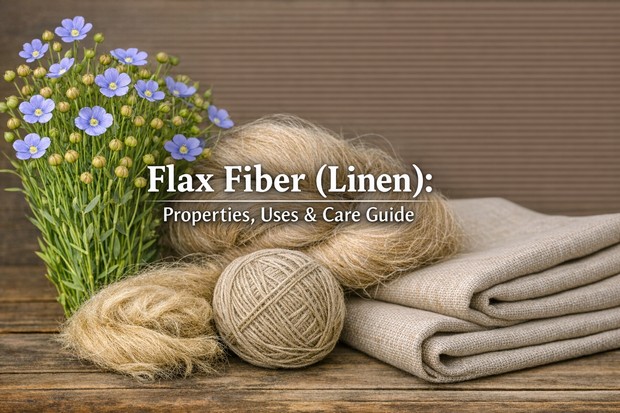
The Flax Plant
Botanical background
The botanical or scientific name of the flax plant is Linum usitatissimum. Usitatissimum is Latin for “most useful”, reflecting the plant’s historical importance. Before cotton became widely available in Western Europe, linen was used extensively in household textiles, for practical and washable garments, and for tents and sails for boats. Its many uses are clearly reflected in the Latin name given to the plant since ancient times.
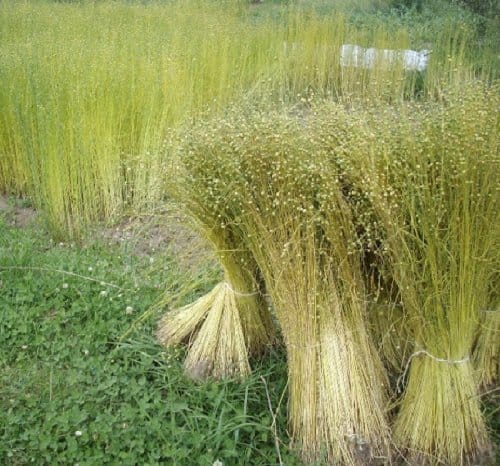
Some varieties are grown primarily for fiber, whereas others are cultivated for their seeds. The plant typically grows to a height of two to four feet and produces flowers with blue or white petals. The fibers occur in bundles in the bast layer of the stem, just underneath the bark. The location of the fibers in the stalk means a considerable amount of woody material must be removed to extract the usable fibers.
Cultivation and Harvesting of Flax
Different varieties of flax are grown either for seed or for fiber. Plants grown for fiber tend to be taller and have fewer branches. Flax thrives in temperate climates with adequate rainfall and is widely cultivated across Europe and in parts of Russia. Limited quantities are grown in the United States, primarily as an experimental crop.
Harvesting typically occurs about eighty to one hundred days after sowing, when about one-half of the seeds are ripe and leaves have fallen from the lower two-thirds of the stem. In regions where inexpensive labor is available, flax is still often harvested by hand; in more developed countries much of the pulling is now mechanized. Whether harvested by hand or machine, the flax plant is pulled completely from the ground to retain as long a stem as possible and to prevent discoloration of the fibers through sap wicking. Stalks are then dried sufficiently so they can be threshed, combed, or beaten to remove the seeds, which are used for sowing future crops, for making linseed oil, or as livestock feed.
Preparation of the Fiber
Bast fibers require extensive processing to remove the fibers from the woody stem in which they are held, a factor that adds considerably to production cost. The basic procedure is similar for all bast fibers. The deseeded flax straw has to be partially biologically rotted to dissolve the substances that hold the fibers in the stem. This first step in preparing the fiber is called retting.
Retting is accomplished through the breakdown of the materials that bind the fibers to the plant stems. Fungi and bacteria secrete highly specific enzymes that attack the binding materials without damaging the fibers.
Retting methods include dew retting, water retting, chemical retting, and enzyme retting.
Dew retting
Dew retting, often called ground retting, is the most common method today. Flax is laid out in swaths on the field where the action of rain and dew together with soil-borne microorganisms loosens the bark; this process usually takes three to six weeks depending on local weather. After retting, the bark is removed and the retted straw is set out to dry in the field. Disadvantages of dew retting include variable fiber quality and limited process control because it depends on naturally occurring microorganisms. Advantages are that it is environmentally benign and relatively easy to mechanize.
Water retting
Water retting occurs when flax is submerged in still or slow-moving water for six to twenty days, with warmer temperatures shortening the time required. It can be done in ponds, vats, or sluggish streams. Water retting tends to yield finer, whiter fibers but is more expensive and creates odors and wastewater that must be managed, so dew retting is often preferred where feasible.
Chemical retting
Chemical retting using caustic agents (for example, sodium hydroxide) or organic acids can accelerate fiber separation, but these processes are rarely used commercially because of cost and environmental concerns.
You may also like: Properties, Classification and Application of Plant Fibres
Enzyme retting
Enzyme retting is a more recent approach in which targeted enzymes are applied under controlled conditions to break down binding substances. Enzyme retting is promising because it can produce high-quality, whiter fibers without the pollution issues associated with water retting, although it is not yet widely implemented on a commercial scale.
Mechanical processing: breaking, scutching, hackling
Retting primarily loosens the bark from the stem. Following retting, mechanical processes called breaking and scutching finish separating the fiber from the woody stem. In breaking, the flax straw is passed over fluted rollers or crushed between slatted frames to fracture the brittle woody portions, called shives, without harming the fibers. In scutching, beaters knock off the broken pieces of stem. The fibers are baled and then shipped to spinning mills. At the mill the fibers undergo further processing before they are ready for spinning. The fibers are hackled, or combed, to separate shorter fibers (called tow) from longer fibers (called line fibers) and to align the fibers parallel in preparation for spinning. Even with this processing, individual fibers tend to remain in bundles, so flax requires specialized machinery for handling and spinning.
Properties of Flax Fiber
Physical properties
- Color: Unbleached flax ranges in color from a light cream to a dark tan. Different retting methods produce color variations: dew retted fibers are typically grayer and darker, while water and enzyme retting produce whiter fibers.
- Shape and length: Fiber bundle lengths range from five to thirty inches. Most long, or line, fibers average twenty to thirty inches, while tow (shorter fiber) is generally under fifteen inches. A process called cottonizing cuts flax to shorter staple lengths for blending with cotton. Single fiber diameters average fifteen to eighteen microns. In cross-section, flax fibers are somewhat irregular and many-sided; they have a central canal (lumen) that is smaller than cotton’s. Flax also shows crosswise markings along its length called nodes or joints.
- Luster: Because flax fiber are straight and relatively smooth, linen is more lustrous than cotton though not as reflective as many manufactured fibers. A traditional finishing treatment called beetling can increase the fabric’s luster.
- Specific gravity: The specific gravity of flax is about 1.54, similar to cotton, so linen fabrics of comparable weave are roughly similar in weight to cotton but heavier than silk or many synthetic fibers.
Mechanical properties
- Strength: Flax is stronger than cotton and is one of the strongest natural fibers; it can be up to about twenty percent stronger when wet than when dry.
- Modulus (stiffness): Flax fiber have a high modulus, which historically made linen suitable for sails and other uses where resistance to deformation under load was important.
- Elasticity and resilience: Flax has lower elongation, elasticity, and resilience than cotton because it lacks the same fibrillar structure. As a result, linen creases and wrinkles more readily unless treated with special finishes.
- Flexibility: Flax fibers can be relatively brittle and offer high resistance to bending; fabrics made from coarse yarns often feel stiff, though very fine yarns can produce softer linens.
Chemical properties
- Absorbency and moisture regain: Linen’s moisture regain is about 11–12%, which is higher than cotton’s, and linen exhibits very good wicking—moisture moves readily along and into the fiber—making it excellent for towels and warm-weather garments.
- Heat and electrical conductivity: Linen conducts heat more readily than cotton and resists static electricity buildup, contributing to comfort in warm conditions.
- Effect of heat and combustibility: Linen is slightly more heat resistant than cotton and requires relatively higher temperatures to scorch. Its burning behavior is similar to cotton: combustible, often continuing to burn after the flame is removed, and producing an odor akin to burning paper.
- Chemical reactivity: Chemically, linen behaves much like cotton because both are cellulose. It is damaged by concentrated mineral acids, relatively unaffected by many bases and common dry-cleaning organic solvents, and is not easily decomposed by typical oxidizing agents under normal conditions. While linen can be mercerized, the natural strength and luster of flax mean mercerization offers few practical advantages.
Environmental resistance
- Microorganisms and insects: If stored damp and warm, linen is susceptible to mildew, but dry linen resists microbial attack. It generally resists rot and bacterial deterioration unless stored wet and dirty. Moths, carpet beetles, and silverfish do not usually damage unstarchd linen.
- Sunlight and aging: Linen tolerates sunlight better than cotton; while there is gradual loss of strength over time, deterioration is not severe if fabrics are properly stored and cared for. However, linen has relatively poor flex abrasion resistance, so repeated folding in the same place can cause cracking and damage.
Other properties
- Dimensional stability: Like cotton, linen swells when wet and has limited dimensional stability. Tension during manufacture can lead to relaxation shrinkage; preshrinking treatments are available to reduce this effect.
- Abrasion resistance: Linen fabrics have moderate to low resistance to abrasion. Their high bending stiffness also contributes to lower flex-abrasion performance.
Common Uses of Linen
Linen experienced a renewal starting in the late twentieth century thanks to improved processing and a growing consumer interest in natural fibers. Yarns spun from flax range from extremely fine counts for sheer, handkerchief-quality linen to coarse, large-diameter yarns for suiting, which allows linen to serve a wide range of apparel uses. Advances in spinning and knitting technology also enabled linen to enter knitted garment markets.
Because of its high moisture absorbency and excellent wicking, linen is popular for summer clothing. The chief downside—wrinkling—can be mitigated with wrinkle-resistant finishes, by blending with synthetic fibers, by using knits, or by prewashing for a soft, relaxed appearance. Blending short-staple, cottonized flax with other fibers also produces softer, less crisp fabrics.

In the home, linen remains prized for tablecloths, napkins, place mats, and tea towels. Tea towels are a classic linen application because long flax fibers produce less lint than cotton, making them ideal for drying glassware. Linen is used alone or in blends for curtains, slipcovers, and upholstery; heavy yarns add interesting texture but the fabric’s lower abrasion resistance can limit heavy-use upholstery applications.
Industrial markets are an expanding outlet for flax and other bast fibers. The primary application is as natural-fiber reinforcement in molded plastic parts—such as interior automotive panels—where embedded flax improves strength and impact resistance. Linen also finds niche use in aircraft restoration and historical biplane coverings.
Because the fiber supply is relatively limited and processing is labor- and time-intensive, linen is often more expensive than many alternatives. This reality has encouraged blending flax with other fibers to reduce cost and improve properties such as wrinkle recovery.
How to Care for Linen
Linen can be either laundered or dry-cleaned. Because linen is stronger when wet, it stands up well to washing, but it is prone to shrinkage and heavy wrinkling if not pretreated or handled correctly. Avoid excessive chlorine bleaching, which damages fibers; controlled and occasional use of oxygen-based bleaches or carefully applied chlorine can whiten linen when needed.
Many care labels still recommend “Dry Clean Only” because dry cleaning limits shrinkage and reduces wrinkling for finished garments. If laundering at home, wash in cool to warm water on a gentle cycle, remove promptly, and reshape while damp to reduce wrinkles. Ironing is most effective on slightly damp linen—use the highest heat setting on many irons and apply steam to remove stubborn creases. To limit wrinkling, dry linen promptly and avoid leaving it bunched in the dryer; tumble drying at a high setting is commonly used, but removing items while slightly damp produces the best finish. For persistent crease reduction, consider professional finishing or wrinkle-resistant fabric treatments.
Conclusion
Flax (linen) remains a valued natural fiber because of its strength, moisture-management, luster, and historic versatility. From apparel and household textiles to growing industrial applications, linen offers unique performance and aesthetic qualities. Its resource-efficient cultivation and strong natural properties make it an attractive choice for consumers and manufacturers seeking durable, breathable, and sustainable textiles.