Last Updated: May 13, 2026
Protein fibers are an important group of natural textile fibers made from amino acids joined in polypeptide chains. They include animal hair fibers and fibers formed from extruded filaments. These fibers are valued for their renewable source, soft hand, and luxury appeal, but they also require careful handling because many are weaker when wet, sensitive to bleach, and damaged by dry heat. This article explains the main protein fibers, their properties, and their uses in modern textiles.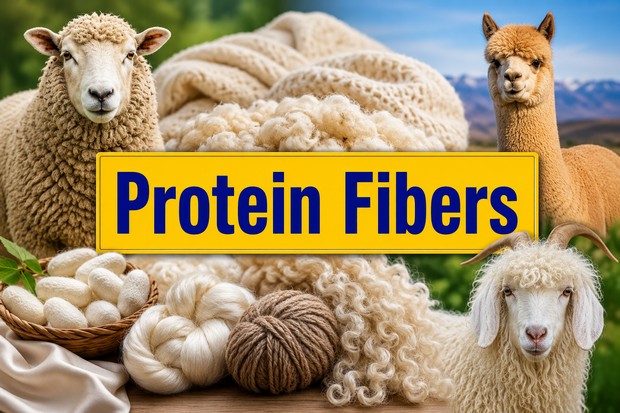
What Are Protein Fibers?
Protein fibers are those fibers in which the basic chemical structure is composed of amino acids joined in polypeptide chains. They may be separated into two basic groups.
Animal Hair Fibers
The major fiber in this group is sheep’s wool. Other fibers of commercial importance come from animals such as the alpaca, camel, cashmere goat, llama, vicuña, guanaco, and the angora goat, whose fleece provides mohair. Also used are qiviut, or hair from the musk ox, angora rabbit hair, fur fiber from animals such as beaver, mink, and rabbit, and cow and horsehair.
Fibers Formed from Extruded Filaments
Silk, produced by the silkworm caterpillar, is the only important fiber in this group. Spider silk, whether naturally or artificially produced, is now being studied for textile uses. In the past, manufactured fibers were produced from a variety of protein sources such as corn, soybeans, and milk. While these early attempts were not commercially successful, manufactured protein fibers are now made from tofu, a soy-derived product.
As with natural cellulosic fibers, textile products made of protein fibers are renewable materials. This can give them a marketing advantage, which has stimulated research and product development on wool and other natural protein fibers. Further, the study of protein fibers from animals has provided researchers with insight into engineering fibers of the future.
Common Properties of Protein Fibers
All protein fibers contain the elements carbon, hydrogen, oxygen, and nitrogen. Wool contains sulfur as well. In each protein fiber, these elements are combined in different arrangements. As a result, properties of the various protein fibers may show some striking differences. Even so, these fibers share a number of common properties.
Protein fibers, except silk, tend to be weaker than cellulosic fibers, and they are weaker wet than dry. Fabrics made from protein fibers must be handled with care during laundering or wet processing. They do, however, as a general rule have greater resilience and elongation than cellulosic fibers. They are more resistant to wrinkling and hold their shape better. Specific gravity of protein fibers tends to be lower than that of cellulose, so fabrics made from these fibers feel lighter in weight than comparable fabrics made from cellulosic fibers.
Fibers from the protein family do not burn as readily as the cellulosics. When set aflame, they may extinguish themselves. Burned fibers smell like burning hair, flesh, or feathers. Protein fibers tend to be damaged by dry heat and should be ironed with a press cloth or steam. Wool and silk require lower ironing temperatures than cotton and linen.
Chemical properties common to most protein fibers include susceptibility to damage by bases and by oxidizing agents, especially chlorine bleach. Like human hair, they should be cleaned with solutions that are pH balanced, that is, neutral or slightly acidic. Strongly alkaline soaps and detergents can damage fabrics made of protein fibers, but acids have less effect than on cellulosic fibers. Fabrics can be bleached safely with hydrogen peroxide, as can human hair, but chlorine bleaches are harmful to these fibers.
Sunlight discolors white fabrics made from protein fibers, turning them yellow after extended exposure. Although wool has better resistance to sunlight than cotton, it will degrade on prolonged exposure. Silk degrades readily on exposure to sunlight.
Wool Fiber
Wool is a protein fiber chiefly composed of keratin. It is a natural, highly crimped protein hair fiber derived from different breeds of sheep such as Merino, Lincoln, and Sussex, among others. Worsted fabrics are made from highly twisted yarns of long fine wool fibers, usually blended with polyester fiber, whereas woolen fabrics are made from less twisted yarns of coarser wool fibers.
The fiber is made up of overlapping cuticle scales and an inner cortex and is slightly elliptical, unlike other animal fibers. Both the cortex and the cuticle influence the wool fiber’s properties, as does the breed of sheep from which it originates. The particular fiber characteristic of specific breeds can be exploited by processing the fiber into appropriate end products. In general terms, wool varies from the super fine Merino producing a fiber similar to cashmere, to very high-luster English breeds producing mohair-like fiber, to coarse hairy wools similar to the guard coat of some goats.
Most animal fibers are protein based, such as silk, wool, catgut, angora, mohair, and alpaca. Wool is obtained from sheep hair. The famous cashmere wool is obtained from the cashmere goat. Though wool really means hairs obtained from sheep, the hairs from other animals are given appropriate names like mohair wool, camel wool, angora rabbit wool, and alpaca wool.
The undesirable hair part of the fleece, which is very weak, stiff, and short in length on the sheep, is called kemp. It does not pick up dye and reduces the quality of the wool. The proportion of kemp to wool varies from sheep to sheep, depending upon the breed. Wool hair has some special characteristics such as crimp, elasticity, special texture, and handle. It is a staple fiber and has typical scales on its surface. This phenomenon, together with crimp, gives clinging power to wool and makes it hold on to the other neighboring fibers.
The crimp varies with fiber fineness. Fine Merino wool may have a very high number of crimps, whereas very coarse wool may have only a few. Wool is hygroscopic in nature and can absorb a large amount of moisture without feeling wet. The fibers also absorb sound. It is generally creamy white, but in some instances, brownish fibers are also seen.
When wool fiber is sheared from the sheep, it contains a sizable proportion of grease, dirt, vegetable matter, and other impurities. After shearing, the good fleece is separated from unwanted broken pieces, bellies, and locks. Grading is also based on the fineness of the fiber. The fineness is generally defined in microns. There are other considerations like length, tensile strength, color, and comfort. Even then, the fiber diameter is the most important criterion used to differentiate quality. Fine wool is generally used for making garments. Very coarse wool fiber goes into outerwear and rugs. Though finer wool is softer, the coarser grades are more durable and less prone to pilling. The best Merino wool from Australia and New Zealand is very soft and fine.
Specialty Hair Fibers
Many hair fibers possess qualities similar to those of wool. These fibers are produced in comparatively small quantities, but they do have an important place in the textile industry, particularly in high-status, prestige clothing items. Because of their limited production and use in luxury textile items, they are sometimes called noble animal fibers.
Cashmere
Cashmere fiber comes from the fleece of the cashmere, or kashmir, goat, an animal native to the Himalaya Mountains region of India, China, and Tibet. Today China and Mongolia are the primary producers. Iran, Afghanistan, New Zealand, and Australia also produce cashmere. The goats are double-coated with fine underhairs and longer, coarser guard hairs. In contrast, sheep have been bred so they are, apart from a few kemps, single-coated.
Only the fine underhair is useful for cashmere fabrics, and one goat can produce only a small amount of usable fiber. These fine fibers can be gathered by combing hairs from the animals during the shedding season. Alternatively, the entire coat can be sheared as is done with sheep. Shearing results in a fleece of mixed guard and fine fibers, so the fleece must then undergo dehairing, a hand or mechanical process to remove the coarse guard hairs.
The softest fibers are short and fine. Coarser and stiffer fibers are longer. Fibers are finer than those in wool, and it is this fineness that gives cashmere fabrics their soft, luxurious hand. Finer wool fibers, however, are now within the range of cashmere, and without documentation of origin, it can be difficult to distinguish these two fibers in blends. This becomes a labeling problem for imported textile items.
The natural color of cashmere is gray, brown, or, less often, white. Microscopically, cashmere displays a scale structure like that of wool, but the scales are thinner. When appropriately measured, scale thickness can be used to distinguish cashmere from wool. The cross section of cashmere fibers is round. The chemical and physical behavior of cashmere is much like that of wool, although cashmere is more quickly damaged by bases. The softness and luster of cashmere combined with its scarcity put this fiber in the category of luxury fibers that are expensive.
The fiber abrades easily because of its softness, and because many of these fabrics are constructed with napped or fleecy surfaces, they require careful handling. Uses are sweaters, coats, jackets, and scarves for men and women. Cashmere is often blended with wool to decrease the cost of the item. It can also be blended with nylon for knits where higher strength and durability are desired.
Camel Hair
The two-humped Bactrian camel of central Asia is the source of camel hair fiber. Camels are both a means of transportation and a source of fibers in China, Mongolia, Iran, and Afghanistan. The traditional method of harvesting camel hair was gathering the hair shed during the molting season in the spring, and for the most part that is still the process used.
Within the collected hair are found both fine, soft down and coarse, bristly hairs. As with cashmere, the clumps of fibers are dehaired to separate the fine and coarse hairs. The soft noils are used for making apparel. Rougher fabrics can be made with some of the coarser grades.
Under the microscope, camel hair shows a scale structure similar to that of wool, but the scales are less visible and less distinctly seen. The cortex is distinct, and the medulla is discontinuous. Both the cortex and medulla are pigmented. This pigment produces the light brown or tan color associated with camel cloth, and because it is not discolored by oxidation, it cannot be removed by bleaching. Therefore, camel fabrics are usually left in their natural color or are dyed to darker shades.
Camel hair provides excellent warmth without weight. It is said to have better insulating qualities than many other hair fibers, being designed by nature to protect the camel from the extremes of heat and cold in its native mountain habitats. The fiber is relatively weak, however, and is subject to damage from abrasion because of its softness. Other physical and chemical properties of camel hair are like those of wool. Most fine camel hair fiber is used for clothing, especially coating fabrics. Like other hair fibers, there is great variety in quality of camel hair fibers, and the consumer must evaluate these products carefully. Because it is easy to dye wool camel color to blend it with camel hair, a final product may be misrepresented as camel hair when, in fact, the quantity of camel hair is relatively low. Camel hair fabric is expensive and should not be selected for its durability, as it tends to wear readily. Coarse camel hair is used for industrial fiber, ropes, and paintbrushes.
Llama
The llama, reportedly native to North America, has been for centuries a source of fiber in the mountainous countries of South America. Today raising llamas has spread again to the northern hemisphere, with small farms in the United States, Canada, and Europe. They are raised not only for their fibers, but also as pets, pack animals, and even guard animals for livestock.
Like cashmere and camel, llama fleece consists of outer guard hairs and finer underhairs that are used for textile fabrics. The animals can be sheared, clipped, or brushed, and the latter method is easily accomplished during shedding. These undercoat fibers are soft and lustrous. They are predominantly black and brown, but some lighter colors are found. Llama fleece is used by many artisans to produce decorative shawls, ponchos, and other products. The fibers, which are often blended, are used for coatings, suitings, and dress fabrics.
Alpaca
Native to Peru, Bolivia, Ecuador, and Argentina, the domesticated alpaca produces a fleece of fine, strong fibers that have a glossy luster. Recently, raising alpacas has begun in other countries as well. The alpaca is sheared in the spring. Alpacas do not have the coat of coarser guard hairs of their llama cousins, so separation of finer fibers from the sheared fleece is not necessary.
Hairs are long and range in color from white to brown to black. Alpaca fiber is stronger and finer than llama or camel hair. It is used in suits, dresses, and upholstery fabrics. It may be made into blends with other fibers. Llamas and alpacas have been crossbred, and the resulting animals have fleece with many of the same qualities and characteristics as those of the parents. An animal with a llama sire and an alpaca dam is called an huarizo. One with a llama dam and an alpaca sire is a misti.
Vicuña
A wild animal, the vicuña lives at very high altitudes in the Andes Mountains. Since the 1970s, the Peruvian government has protected the vicuña, and the population has now stabilized to a healthy level. Highland farmers now herd and shear the animals, no longer killing them for their luxurious fibers.
The vicuña grows a fleece of very fine underhairs and a coat of guard hairs that are also fine and, therefore, difficult to distinguish. One vicuña yields only a small amount of extremely fine fiber and a larger amount of less fine fiber. The fibers are very light and short, so spinning is a challenge. One of the softest fibers known, vicuña is also the costliest. A vicuña coat is comparable in cost to a good fur coat. Its use is limited to luxury items. The natural color, a light tan or chestnut brown, is usually retained as the fiber is hard to dye.
Guanaco
Another wild animal, the guanaco, is herded and sheared in the same manner as the vicuña. Although supplies of the fiber are more readily available than vicuña, it remains a relatively expensive fiber. The guanaco is double coated with a layer of guard hairs, which are separated to leave the finer underhairs. They are premium fibers because they are soft and fine and the animal is a rare, protected species. Guanaco fibers are finer than alpaca and shorter than vicuña. They are usually reddish brown in color.
Mohair
Mohair fiber is taken from the angora goat. The world’s supply of mohair has declined dramatically over the past two decades and stands at less than one percent of natural fibers. South Africa is the largest producer. The United States follows, mainly from goats raised in Texas.
Angora goats, unlike their cashmere counterparts, have a single coat of hairs and so are sheared in the same way as sheep. Fleece is removed twice a year. Each animal yields from three to five pounds a year of four- to six-inch fiber. To obtain a supply of slightly longer fiber, some goats are sheared only once a year. The natural color of unscoured fleece is yellow to grayish white. Cleaning removes 15 to 25 percent of the weight. The clean fibers are white in color, silky, and fine in feel and appearance. Fibers are graded, with kids’ or young goats’ fleeces especially valued for their fineness.
The cross section of the fiber is round, with the medulla being only rarely visible. Small air ducts are present between the cells of the fiber, which give it a light, fluffy feeling. The microscopic appearance of mohair is similar to that of wool.
Most of the physical and chemical properties of mohair are very similar to those of wool. Mohair’s high affinity for dyes makes it especially attractive for blending with wool and other animal hair fibers. The major differences between wool and mohair are the very high luster of mohair and its slippery, smooth surface. Mohair is especially resistant to abrasion. When viewed under the microscope, mohair shows fewer scales than wool. As a result, the fiber sheds dust and soil and neither shrinks nor felts as readily as wool. Mohair is easier to launder, as well.
The current uses of mohair stress products where its luster can be used to good advantage, and these include men’s and women’s suitings, upholstery fabrics, carpets, and draperies. Novelty yarns, such as looped or bouclé yarns, are often made of mohair, and mohair is blended with other fibers. The cost of mohair fabrics tends to be higher than that of wool. The quality of mohair can vary a good deal, so the consumer must evaluate mohair products carefully.
Qiviut
Qiviut is the underwool of the domesticated musk ox. Herds of musk oxen are cultivated in Alaska. These animals shed in the spring, at which time they are combed and the fine underwool is machine spun. Yarns are sent to local women in villages in the region, and they hand-knit a variety of products. Each village has a distinctive pattern unique to that settlement.
The fiber is similar to cashmere in texture and softness. A small amount of qiviut will make a large, warm sweater. An equivalent garment in sheep’s wool would require much more fiber. Qiviut, like many specialty hair fibers that are in short supply, is very expensive.
Fur Fibers
Fibers from the pelts of fur-bearing animals are usually left on the skin, which must be treated in a process similar to tanning. The fibers can, however, be removed and blended with other wool fibers to provide interest and soft texture. Fur fibers from animals such as the beaver, fox, mink, chinchilla, rabbit, and the like are used.
If fur fiber has been removed from the skin and incorporated in a textile product, it is designated as fur fiber and is subject to regulation under the textile labeling laws. Fur that is attached to the animal skin is regulated by the Fur Products Labeling Act. This legislation requires that all fur products carry the true English name of the fur-bearing animal from which the fur comes. It also requires that furs be labeled with the country of their origin. No fur may be given a trademark name of a fictitious or nonexistent animal. If furs have been worn or used by the ultimate consumer, they must be designated as used fur. When fur is damaged from natural causes or from processing, it must be labeled as containing damaged fur. Any dyeing or bleaching or other treatments given to artificially color the fur must be disclosed.
Angora
Angora is the fiber from Angora rabbits. These rabbits have long, fine, silky, white hair. The rabbits are raised in France, Italy, Japan, and the United States. The fiber is obtained by combing or clipping the rabbits. Angora rabbit fiber is exceptionally fine, but it is slippery and hard to spin.
Angora is used chiefly in novelty items and is often knitted. Sweaters are often made of angora blended with nylon and wool. The fibers tend to slip out of the yarns and increase in length on the surface of the fabrics, so some persons have the mistaken notion that angora hair grows.
Cow Hair and Horsehair
Cow hair is sometimes blended with wool in low-grade fabrics used for carpeting and blankets and in felts. Horsehair serves as a filling or stuffing material for mattresses and upholstered pieces. In the past it was woven into a stiff braid for use in millinery or dressmaking, but this use has been replaced, for the most part, by synthetic fibers. Rubberized horsehair has been used to make carpet underlays.
Silk Fiber
Silk is one of the oldest fibers known to people. Out of many silk-producing countries, China’s share is almost half, and India also produces a significant amount. The cultivation activity is called sericulture. The fibers are recovered from the cocoons formed by silkworms. Several other types of moths prepare such cocoons, but the thread obtained from silkworms is far superior. The silkworm is typically grown on mulberry trees.
The cocoons contain a large number of layers of silk thread, and they vary in softness and structure. At the time of cocoon formation, two primary glands under the head of the larva secrete silk threads, called fibroin, which are bound together by sericin, a protein in the form of a glue. Silk is an animal fiber produced by certain insects to build their cocoons and webs, and it is the only natural fiber that occurs in filament form. Although many insects produce silk, only the filament produced by the larvae of the cultivated B. mori moth and a few others in the same genus are used by the commercial silk industry.
Silk has been used and regarded as a highly valued textile fiber for thousands of years. It is still considered a premier textile material in the world today because of its tensile strength, luster, and ability to bind chemical dyes. Silk fibers are remarkable materials displaying unusual mechanical properties, such as being strong, extensible, and mechanically compressible. Despite facing keen competition from man-made fibers, silk has maintained its supremacy in the production of luxury apparel and high-quality specialized goods. It has been referred to as the queen of textiles for its luster, sensuousness, and glamour.
Silk’s natural beauty and the property of remaining cool in warm weather while providing warmth during colder months have ensured its continued use in high-fashion clothing. Silk fibers have outstanding natural properties that rival advanced synthetic polymers, yet their production does not require harsh processing conditions, encouraging ongoing research into the possibility of artificially produced silk fibers.
Silk Production
Besides the growing of mulberry trees, the production of silk can be viewed as a culmination of several separate stages: sericulture, silk reeling to obtain the raw silk filament thread, and throwing, which converts the harvested thread into usable yarn for fabric production.
Spider Silk
Protein filaments are spun not only by wild and cultured silkworms, but also by many species of spiders. The chemical makeup of spider silk is determined not only by the spider species, but also by diet, weather, and other factors. It is similar to silk from silkworms in that it contains no sulfur. Spider silk has some unique features, which have spurred researchers to attempt to produce an artificial spider silk.
Spider silk fibers are round in cross section and, with a diameter much finer than silkworm filaments. The fibers that anchor the web and support the spider are known as dragline silk. The fibers in spiderwebs have higher tenacity and elongation than silk, giving them the ability to absorb the impact energy needed to catch and hold the spider’s prey. The fibers would thus be very desirable, especially for high-performance end uses where impact resistance is important.
Although domesticating spiders for production of fibers is not a realistic endeavor, researchers have attempted to mimic the process of spinning spider silk to produce fibers with this unique combination of high strength, high elongation, and very low weight. Using molecular genetics, spider silk proteins have been synthesized by injecting genes from the spiders into yeasts, plants, or animals. Currently, all such efforts are still experimental in nature, but there is much to be gained from producing such an advanced material by a sustainable method.
Regenerated Protein Fibers
Some years ago corn, peanuts, and soybeans were used as starting materials for regenerated protein fibers. The generic name for these fibers is azlon. Although these earlier attempts were not commercially successful, renewed interest in environmentally sustainable products has resulted in the manufacture of a fiber branded as Soysilk. The starting material is the protein remaining after production of tofu, a soy product. The fibers are advertised as soft, smooth, and lustrous. They are sold in yarns for hand knitting.
How to Identify Natural Protein Fibers
Natural protein fibers can be identified with a microscope fairly easily. Wool fibers have scales that are visible along the edge and, if the fiber is white or pastel, may be seen throughout the length of the fiber. It is difficult to distinguish among the wool fibers because of their similar appearance. For example, it is easy to distinguish wool from cotton, but it is difficult to distinguish sheep’s wool from camel hair. Correct identification of the various specialty wools is difficult but necessary because of fraudulent blends that are labeled 100% cashmere or other luxury fiber.
Silk can be identified with a microscope, but with greater difficulty. Since silk is a natural fiber, its surface is not as regular as that of most manufactured fibers. The cross section may not be apparent, but the fiber has slight bumps or other irregularities.
Natural protein fibers are soluble in sodium hypochlorite. In the burn test, these fibers smell like burning hair. However, the odor is so strong that a very small percentage of protein fiber produces a noticeable hair odor. Hence, the burn test is not reliable for blends, nor will it distinguish among the protein fibers.
Conclusion
Protein fibers remain important because they combine renewable origin, comfort, warmth, and luxury. Wool is still the most widely used animal hair fiber, while cashmere, camel hair, mohair, alpaca, vicuña, guanaco, qiviut, angora, and silk support specialty and high-end markets. Their care requirements are strict, since many protein fibers are affected by bleach, sunlight, bases, and dry heat. Even so, these fibers continue to shape apparel, accessories, home textiles, and new research into sustainable materials.