Last Updated: September 14, 2026
How Manufactured Fibers Are Made
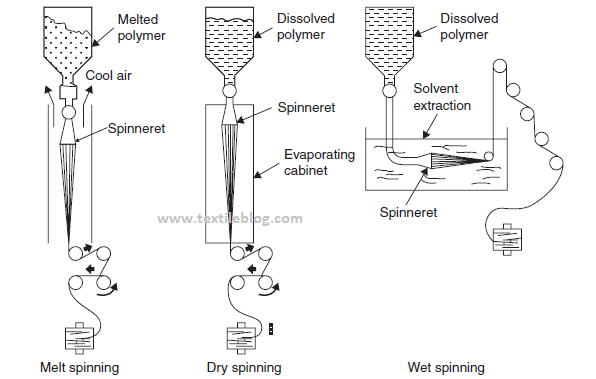
Manufactured fibers have revolutionized the textile industry by offering versatility, durability, and cost efficiency beyond what natural fibers alone can provide. From the polyester in your activewear to the rayon in a summer dress, manufactured fibers are everywhere. Manufactured fibers play a central role in modern textiles, offering controlled properties that natural fibers cannot always provide. Using heat or a solvent to create a liquid version of a polymer substance is fundamentally the basis of the manufacture of fibers. This liquid can be forced through a showerhead device called a spinneret, and the narrow streams of liquid then become solidified into long, thin fibers. The basic steps in producing manufactured fibers are shown in below figure.

Additives Used in Manufactured Fibers
Whether it is a solution or a melt, the liquid form of the polymer is an excellent opportunity to add substances that will provide modified characteristics to the fiber that is spun.
Delustrants and Optical Whiteners
Many manufactured fibers are naturally bright, with a high luster. If brightness is not required, and to increase the opacity of the fibers, a delustering agent can be added to the liquid polymer to scatter light rays. Titanium dioxide is almost invariably used as the delustrant, and most manufactured fibers contain some of it. When viewed under the microscope, it appears as small, dark specks within the fiber, and seeing them is evidence that the fiber is a manufactured one. Adding a small amount of delustrant produces a semidull fiber, while adding more produces a dull fiber. Fibers without delustrant are called bright. Whiteness can also be enhanced by the inclusion of a fluorescent brightening agent, also referred to as an optical whitener.
Adding Color to Fibers
Color, in the form of dyes and pigments, can also be added to the polymer liquid. The addition of color to the liquid has gone under many names, but the current term is solution dyeing (even though it may not be a solution, and it is not truly “dyeing”). Thus “solution-dyed” polyester refers to polyester that is colored as part of the fiber manufacturing process. Because the spinning liquid for acetate fibers was originally known as “dope,” dope dyeing is another name. Mass coloration and mass pigmentation have also been used. The advantages and disadvantages of coloration in this way are important, but the method is very useful for fibers, notably olefin, that are difficult to dye.
Flame Retardant Additives
The burning behavior of a fiber can be reduced by the inclusion of flame-retardant additives into the melt or solution before spinning. This is generally more durable than applying the chemicals as a finish after the fiber has been spun and turned into a fabric. Polyester and rayon have probably been the fibers most often treated this way.
UV Stabilizers
Some fibers are prone to the action of ultraviolet light, or of atmospheric weathering. When they are used in outdoor applications (such as all-weather carpet or awnings, for example) they can quickly degrade. Ultraviolet absorbers and antioxidants can be added to the melt or solution to produce a fiber that is more durable in such applications.
Antimicrobial Additives
Antimicrobial fibers have been created by the addition of substances that slowly leach out over the life of the fiber.
Fiber Spinning Methods
After careful filtration to remove material that might clog the spinneret holes, the liquid polymer melt or solution is then extruded through a spinneret to create the fibers. Each spinneret has a number of holes, and each hole produces one filament. As they exit the spinneret, the fibers are solidified. The method of solidification forms the basis of melt spinning, dry spinning, and wet spinning, which are the three primary fiber-spinning processes, discussed below.
The solidified fibers that emerge from one spinneret may form a filament yarn directly. The number of holes in the spinneret will determine the number of filaments in the yarn. When fibers being extruded are intended for conversion into staple yarns, spinnerets with larger numbers of holes are used (or the filaments from several spinnerets are collected together) to produce filament tow that is later cut into staple lengths. In either case, spinneret holes are spaced to allow the filaments to be extruded without touching each other. The metal used in the plate must be capable of withstanding high temperatures, high pressures, or corrosive spinning solutions. The spinning system also controls the size and shape of the fibers produced.
Contrary to expectation, the size of the fiber produced depends less on the size of the hole and more on the pressure used to force the liquid through the spinneret, and the rate at which the fiber is drawn away from the spinning zone. The shape of the hole controls the shape of the fiber, but an exaggerated shape is required because the liquid stream that emerges will tend toward roundness (minimizing surface area). Melt-spun fibers may be made through Y-shaped holes that yield a three-lobed fiber or C-shaped holes to produce a hollow filament, for example.
Melt Spinning Process
Chips of solid polymer about the size of rice grains are dropped from a hopper into a melter where heat converts the solid polymer into a viscous liquid. The liquid forms a “melt pool” that is pumped to the spinneret at a carefully controlled rate of flow. Because it does not involve the expense of solvents and their recovery, melt spinning is simpler and cheaper than other spinning methods and is used when at all possible. Nylon was the first melt-spun fiber. Polyester and olefin are also melt spun. When the molten polymer emerges from the spinneret hole, a cool air current is passed over the fiber, causing it to harden.
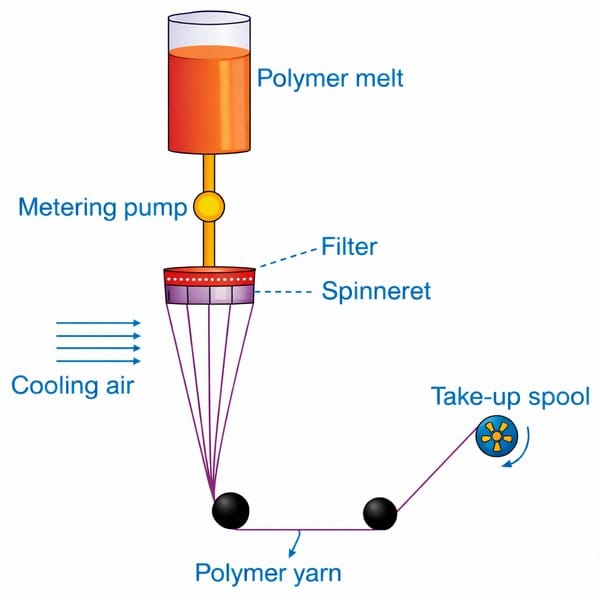
Like many other textile processes, melt spinning has become faster and more efficient. Processing speed has increased significantly, and today higher-speed spinning is cost effective and, up to a certain point, increases the orientation of the polymers in the fibers. Beyond a certain speed, however, this advantage disappears as there is not enough time for the polymers to crystallize and the fibers may break.
Dry Spinning Process
Polymers that cannot be melt spun are dissolved in a solvent in order to be formed into fibers. Solvents are chosen not only for their ability to dissolve the polymer, but also for their safety in use and ability to be reclaimed and reused. The solvent must be removed to solidify the fibers, and if it is relatively volatile, the most straightforward means of doing so is by evaporation. This is the basis of dry spinning.
You may also like: Chemical Fiber Spinning Methods for Filament Yarns
The polymer and solvent are extruded through a spinneret into a circulating current of hot gas in a chamber called a spinning cell. The solvent evaporates from the polymer and causes the filament to harden. The solvent is removed and recovered from the stream of air to be recycled. Dry-spun filaments generally have an irregular cross section. Because the solvent evaporates first from the outside of the fiber, a hard surface skin of solid polymer forms. As the solvent evaporates from the inner part of the fiber, this skin “collapses” or folds to produce an irregular shape. If the rate of evaporation is slowed, the cross section of the filament will be more nearly round.
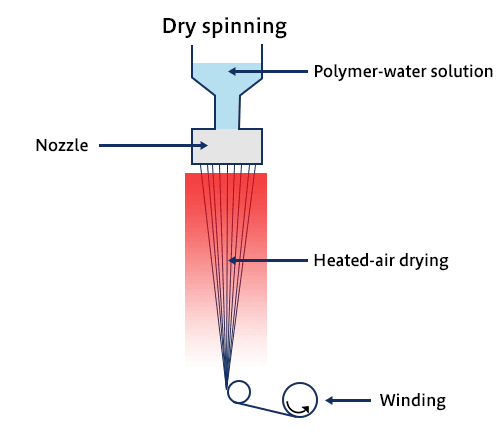
Acetate fibers were the first to be dry spun. Meta-aramid fibers, most spandex, and some acrylic fibers are also dry spun.
Wet Spinning Process
Wet-spun polymers are, like dry-spun polymers, converted into liquid form by dissolving them in a suitable solvent. The polymer solution is extruded through a jet into a liquid bath. The bath washes away the solvent and causes coagulation and precipitation of the fiber. Like those produced by dry spinning, these fibers tend to have an irregular cross section from the initial formation of a “skin” that later collapses. Solvents are usually recovered from the liquid bath and are recycled. Viscose rayon and some acrylics are wet spun.
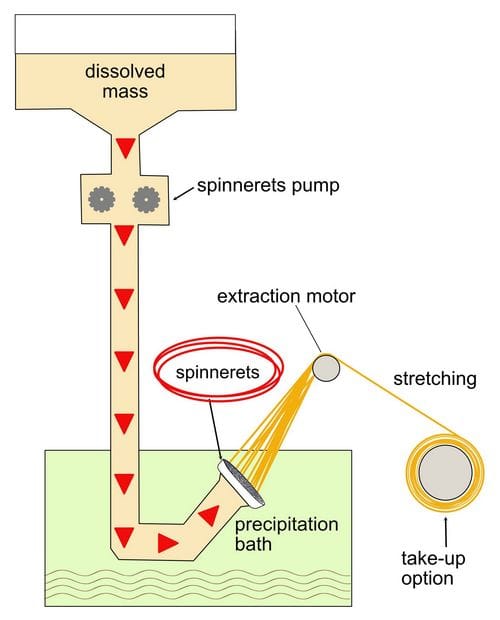
The chemical composition of the bath can be varied to provide changes in the detailed properties of the fiber. This is done in the manufacture of some versions of rayon, for example.
Dry-Jet Wet Spinning
A variant of wet spinning, called dry-jet wet spinning, has been developed to produce some of the newer fibers such as lyocell and the para-aramids. Instead of the spinneret being immersed in the spinning bath, it is placed slightly above the bath so there is a small air gap, usually less than an inch. The fibers exiting the spinneret can be stretched to orient the molecules before they enter the bath to be solidified. This process develops high orientation and crystallinity in one step, rather than in drawing in a separate step.
Specialized Fiber Spinning Methods
Although melt-, dry-, and wet-spinning techniques are used to form the vast majority of manufactured fibers, several other spinning techniques have been developed for specialized situations. High-molecular-weight polymers, such as those in Spectra polyethylene, are formed by solution spinning or gel spinning. As in wet and dry spinning, the polymer is dissolved in a solvent. The polymer and solvent together form a viscous gel that can be processed on conventional melt-spinning equipment to form a gel-like fiber strand. Later in the processing, the solvent is extracted and the fibers stretched.
Fibers made from polymers that have extremely high melting points and are insoluble present obvious difficulties in spinning. Such materials may be spun by a complex process called emulsion spinning in which small, fibrous polymers are formed into an emulsion, aligned by passing the emulsion through a capillary, then fused or sintered (combined by treating with heat without melting), passed through the spinneret into a coagulating bath, and subsequently stretched.
Conclusion
Manufactured fibers can be tailored at the polymer stage and then formed through the spinning method that best fits the final product. This flexibility is one reason they are widely used in modern textiles.