Last Updated: July 15, 2026
Introduction
Silk is one of the oldest and most admired natural fibers in the world. It is valued for its smooth feel, bright luster, strong filament structure, and elegant drape. This article explains where silk comes from, how it is produced, what makes it different from other fibers, and how to care for it properly. It also gives a clear overview of silk’s main properties, common uses, and special finishes, so readers can understand why silk remains a luxury textile today.
What Is Silk?
Silk is a natural protein fiber. It is similar to wool in that it is composed of amino acids arranged in a polypeptide chain, but it has no cross-links, which gives the fiber a more continuous and filament-like structure. Silk is produced by the larvae of a moth.
Silk is one of the oldest fibers known to humans. It is an animal fiber produced by certain insects to build their cocoons and webs, and it is the only natural fiber that occurs in filament form. Although many insects produce silk, only the filament produced by the larvae of the cultivated Bombyx mori moth and a few others in the same genus are used by the commercial silk industry.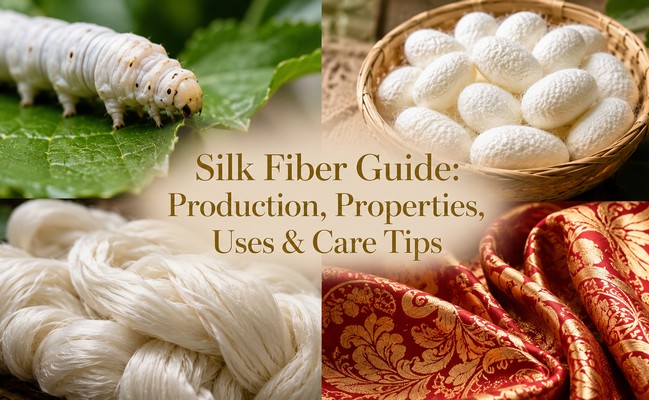
Silk is a protein fiber of insect origin, being produced as a fine filament of long length from the body fluid of the silkworm. The silkworms eat only the leaves of the mulberry tree. Silk is a polypeptide, formed from four different amino acids, which give the fiber its protein-based strength and unique hand.
Silk fibers are relatively stiff and show good to excellent recovery from deformation depending on the temperature and humidity conditions. These fibers exhibit favorable heat-insulating properties, but owing to their moderate electrical resistivity, they tend to build up static charge.
Silk History and Origin
Silk originated in China, the first habitat of the silkworm, which grew wild and lived on the leaves of a species of mulberry tree. Although some animal hair and flax fibers can grow to considerable length, silk is the only natural fiber that is hundreds of meters long. Its continuous length is one of the main reasons it can be reeled into fine yarn so effectively.
Silk is made by the silkworm as it builds its cocoon. The substance is extruded from its body in one continuous strand from beginning to end. It is possible to unwind the cocoons and obtain long silk filaments. The Chinese discovered this process and, recognizing the potential value of the fiber it produced, guarded the method closely for hundreds of years. Silk has a natural beauty, and its history has been surrounded by legends.
Chinese folklore credits the discovery of silk to Princess Si Ling Chi. According to legend, she noticed a silkworm spinning a cocoon in her garden and then experimented with unwinding the long filaments. After much experimentation, she succeeded. She instructed her serving women in the art of weaving rich and beautiful fabrics from the long silk threads. So grateful were the Chinese for her discovery that they transformed Princess Si Ling Chi into a goddess and made her the patron deity of weaving.
How Silk Is Made
Silkworm Cultivation
Silk is the only natural filament fiber that has significant commercial value. Produced by a caterpillar known as a silkworm, silk can be obtained either from cultivated silkworms, Bombyx mori, or wild species. Silk from wild species is limited in quantity and produces a coarser, stronger, short fiber known as tussah silk. Tussah silk has short fibers because the cocoons from which it is taken have been broken or pierced. When wild silk is spun by caterpillars that feed on oak leaves, the silk is light brown or tan in color and cannot be bleached.
By far the largest quantity of silk comes from sericulture, the controlled growth of domesticated silkworms to produce the silk fiber. Whether the silkworms are domesticated or wild, they go through four basic stages of development: egg laying, hatching into caterpillars that feed on mulberry leaves, spinning a cocoon, and emerging as the silk moth. The science of sericulture has been perfected over many thousands of years. Today all stages of development are carefully controlled, and only the healthiest eggs, worms, and moths are used for the production of silk.
Selected moths of superior size lay several hundred eggs on prepared cards or strips of cloth. Each seed is about the size of a pinhead. These eggs can be stored in cool, dry places until the manufacturer wishes to begin incubation. Incubation is done in a mildly warm atmosphere and requires about thirty days. At the end of this time, the silkworms hatch. They are about one-eighth inch in length.
The young silkworms require constant care and carefully controlled diets. Shredded or chopped young mulberry leaves are fed to the worms five times each day. Worms that appear to be weak or deformed are discarded. The areas in which worms are grown are kept scrupulously clean. For about a month, the worm grows, shedding its skin four times. When fully grown, worms are about three and a half inches in length.
When its size and activity show that the worm is about ready to begin to spin a cocoon, the silkworm is transferred to a surface of twigs or straw. From two sacs located in the lower jaw, the worm extrudes a substance made up of two strands of silk, fibroin, and a gummy material, sericin, that holds them together. Moving its head in the shape of a figure eight, the worm surrounds itself with a cocoon of up to sixteen hundred meters of fiber. The completed cocoon is about the size of a peanut shell and takes two to three days to spin.
If the worm is permitted to live, it will change into a pupa or chrysalis, then into a moth. After two weeks, the moth breaks through the cocoon and emerges, mates, lays eggs, and begins the cycle again. Only those moths selected as breeding stock are permitted to complete the cycle. These are selected from the largest and heaviest cocoons. The rest of the cocoons are subjected to dry heat that kills the pupa.
Occasionally, two silkworms will spin a cocoon together. This produces a cocoon made of a double strand of silk and is known as doupion silk.
Reeling, Throwing, and Degumming
The whole, unbroken cocoons are sorted according to color, texture, size, shape, and other factors that affect the quality of the fiber. Reeling of silk is, to a large extent, a hand operation done in a factory called a filature. Several cocoons are placed in a container of water at about 140°F. This warm water serves to soften the sericin, the gum that holds the filaments of silk together. Little of this gum is actually removed in reeling. The outer fibers are coarse and short and not useful in filament silk. They are separated and are used for spun silk, which is made from short fiber lengths. The filaments from four or more cocoons are held together to form a strand of yarn. As the reeling continues, a skilled operator adds or lets off filaments as needed to make a smoother strand of uniform size. Several skeins of silk weighing fifty to one hundred grams each are combined into a bundle. Each bundle is called a book and weighs from five to ten pounds. These are packaged into bales for shipping.
The making of silk filament yarns is called throwing. Reeled silk filaments can be combined into yarns immediately. Short, staple-length silk fibers must be spun. Short outside fibers of the silkworm’s cocoon, the inner fibers from the cocoon, and the fiber from pierced cocoons are known as frisons and are made into spun silk yarns. Fibers are cut into fairly uniform lengths, combed, and twisted into yarns in the same way that other staple fibers are spun.
As mentioned earlier, the sericin that holds the silk filaments in place in the cocoon is softened but not removed in reeling. This gummy material makes up about 25 percent of the weight of raw silk. It is removed before throwing, after throwing, or after the fabric has been woven. A soap solution is used to wash the gum from the silk. In some silk fabrics, called raw silk, the sericin has not been removed.
Silk Weighting and Production Regions
During the latter part of the nineteenth century, the technique of weighting was employed extensively to add body and weight to silk fabrics after removal of the gum. In passing silk through a solution of metallic salts, the salts are absorbed by the fiber, with a corresponding increase in the weight of the fabric. Silk can absorb more than its own weight in metallic salts, so this excess weight will eventually cause the fabric to break. This practice became so widespread that poor-quality fabric was being sold as silk. Because the buyer could not tell from appearance or hand that the silk had been weighted, the Federal Trade Commission began overseeing silk weighting in 1938 through its pure silk regulations.
These FTC regulations are still in effect. Other than some weighting of silk for neckties and for products requiring especially heavy fabrics, few silk fabrics are now weighted. The regulations require that fabrics labeled silk or pure dye silk contain from 0 to 10 percent weighting. All silk fabrics that have more than 10 percent weighting must be labeled as weighted silk unless they are black in color. Black silks can be weighted up to 15 percent because they can hold a greater quantity of weighting without degradation.
Because the culture of silkworms requires so much hand labor, sericulture has been most successful in countries where labor is less expensive. Commercial silk production is concentrated in China, India, Japan, and Brazil. China is the largest silk producer in the world. Italy is the largest exporter of finished silk goods, but it imports the silk fiber from which those goods are made. This is also true of England and France, which produce finished silk fabrics. Increasingly, China is also engaged in processing silk fibers in addition to producing raw silk.
Silk Fiber Structure and Properties
Silk, like wool, is composed of polypeptide chains, but it has fewer amino acids and no sulfur linkages. The polymer molecules are not coiled but extended. This structure allows the chains to be packed more tightly, increasing the crystallinity of the fiber. Hydrogen bonds and salt bridges cross-link adjacent molecules, contributing to the strength.
Physical Properties of Silk
The natural color of cultivated silk is off-white to cream. Wild silk is brown. The cross section of silk is triangular in shape. The fiber has a smooth, transparent, rodlike shape with occasional swelling or irregularities along its length. It is fine, having a diameter of nine to eleven microns, and filaments may be as short as three hundred meters or as long as one thousand meters. Individual filaments as long as three thousand meters have been measured. This very long filament length is one of silk’s most distinctive features.
The luster of degummed silk is high but not as bright as manufactured fibers with round cross sections. Although the surface of the fiber is smooth, the roughly triangular shape changes the pattern of light reflection. The specific gravity of silk is less than that of cellulose fibers and is similar to that of wool. Lightweight fabrics can be made of silk because of the fine diameter of the fiber and its high tenacity.
Mechanical Properties of Silk
Silk is one of the strongest of the natural fibers. Its tenacity is 2.8 to 5.2 g/d. It is stronger than wool because of its higher crystallinity. Its wet strength is slightly less than its dry strength because the hydrogen bonds between protein polymers are broken by moisture.
Silk has a moderately high modulus. This means that it will resist an initial tensile force more than will wool and will not stretch as easily. The elongation of silk fibers before breaking is about half that of wool but considerably higher than cotton. It has fairly good recovery if stretched only slightly but will not recover completely from high extensions. Silk has a moderate degree of resilience. Creases will hang out of silk, particularly under moist conditions, but its wrinkle recovery is slower and not as good as that of wool.
Chemical Properties of Silk
The absorbency of silk is good, with a moisture regain of 11 percent, making it a comfortable fiber to wear. Silk can be printed and dyed easily to bright, clear colors if appropriate dyes are used. The heat conductivity of silk is low, so densely woven fabrics can be relatively warm. However, because sheer, lightweight fabrics also can be woven from silk, it can be used for lightweight, summer clothing.
Because the electrical conductivity of silk is not high, silk tends to build up static electricity charges, especially in dry atmospheres. When placed in a direct flame, silk will burn, but when the flame is removed, the silk may self-extinguish. Therefore, silk is not considered an especially combustible fabric. Like wool, silk is damaged by dry heat and should be ironed damp, at low temperatures, and using a press cloth.
You may also like: Types of Silk and Their Characteristics
Like other protein fibers, silk is sensitive to the action of bases. Acids will harm silk more quickly than they harm wool. Chlorine bleach deteriorates the fiber, but hydrogen peroxide or other oxygen bleaches can be used. Organic chemical solvents used in dry cleaning will not affect silk. Perspiration will cause deterioration of the fabric. It can also affect dyes, causing discoloration after repeated exposure, so silk fabrics should always be cleaned before they are stored.
Environmental and Durability Properties
Mildew is not a problem with silk. Moths do not harm clean silk, but carpet beetles will attack the fabric. Sunlight deteriorates silk even more rapidly than it does wool, causing white fabrics to yellow. Age will lead to eventual deterioration of fabric strength. Silk fabrics should be stored away from light. Antique fabrics should be sealed off from the air. Weighting of silk causes it to crack, split, and deteriorate much more quickly than it would otherwise. Historic items made of silk before silk weighting was introduced may still be in good condition, while weighted silk garments often shred and break apart.
The dimensional stability of silk is moderate. It does not stretch to any significant extent but may exhibit relaxation shrinkage because of its higher moisture absorbency. Silk is not resistant to abrasion. While the fibers themselves have some ability to absorb energy, their fineness makes them vulnerable to wear. Filament silk fabrics will not pill under abrasive action.
Special Finishes on Silk
Silk has long been considered a luxury fabric, delicate and requiring special care. Popular casual silk garments, such as shirts and jeans, introduced in the 1970s, were given a special finish called sandwashing. These garments had an attractive faded appearance; they were soft, supple, and, most important, washable. Washed silks, even though expensive, became popular, and by the 1980s, major American designers had put them into their collections.
As washable silks gained in popularity, other finishes were used to alter their hand. Sueded silk was finished with a slight nap. Treatment with alkali broke down the sericin coating, caused small pits in the fibers, and raised short fibers during tumble drying. To make apparel easier to care for, soil- and stain-resistant finishes were also applied.
Common Uses of Silk
The beauty of silk fabrics is legendary. For many centuries, silk was synonymous with luxury and was used for garments worn on feast days, festivals, and other occasions of great importance. Wall hangings of silk were used to decorate the homes of the wealthy, and carpets woven of silk were used in the homes of the rich in Persia and China.
The increased use of washable silk in casual clothing and larger supplies worldwide have made silk items increasingly available to most consumers. Although the quality may vary, the range of apparel for which silk is used has expanded in recent years. Silk or silk blends can be found in women’s dresses, blouses, slacks, and lingerie; men’s trousers, shirts, and neckties; knitted cold-weather underwear; and various accessories. Raw silk is popular for summer-weight suits and jackets. Silk may also be found in some high-priced drapery and upholstery fabrics.
The performance of silk fabrics in these uses is rather poor. Upholstery fabrics of silk are often made in weaves that show off the luster of the fabric but abrade easily. Sunlight will deteriorate drapery fabrics of silk. Draperies made of silk should be lined with some other fabric to protect the silk from constant exposure to the sun.
How to Care for Silk
Silk fabrics should be stored away from direct sunlight both to avoid yellowing of white fabrics and to prevent loss of strength. Long-term storage of silk wedding gowns or other items is best done in containers that are sealed against air and carpet beetles. Care labels should be followed to determine the best care procedures for individual silk garments.
Some dyes used on silk are susceptible to bleeding or loss of the dye. Check by wetting a small and inconspicuous spot, perhaps a seam or facing area, and blot the damp area between paper towels, pressing hard. If color appears on the paper towel, the fabric is not colorfast and should be dry-cleaned. Today many silks have been dyed with dyes that do not fade in water, making the items washable. Even for silk items labeled as washable, care labels should be followed closely to avoid problems.
When washing the textiles by hand, launder in a mild detergent that contains no added alkali. Do not wring or scrub, especially on fabrics made from smooth, solid-color filaments where wear is more likely to show. Chlorine bleach should never be used on silk. Rinse garments thoroughly, then roll them in a clean bath towel to absorb excess moisture.
If machine washing is recommended, use a gentle, two-minute wash cycle, lukewarm water, and mild detergent. Do not tumble dry unless care labels direct, as the surface may be abraded or the fabric may be more likely to shrink. To dry, place the garment on plastic hangers, since wire hangers can cause rust stains. Iron while still damp at low temperatures of 300°F or lower. Although badly wrinkled silk fabrics will require pressing, many creases will hang out of silk fabrics without ironing, especially those with a soft, casual look. Washable silks should not be dry-cleaned because their dyes can be removed or lightened by dry-cleaning solvents.
Conclusion
Silk remains a premium natural fiber because it combines beauty, comfort, and strength in one elegant material. From sericulture and reeling to modern finishes and fashion uses, silk has a long textile history and a unique place in global manufacturing. Its delicate appearance does not mean it is fragile in every way, but it does need careful storage and cleaning. With the right care, silk garments and home textiles can stay attractive and wearable for a long time.