Introduction
Apparel and home textile producers have long wanted a cellulose fiber that offers the soft drape of rayon without giving up too much strength or easy care. Lyocell fits that need well. It was first produced commercially by Courtaulds under the brand name Tencel®, and the Lenzing Group acquired Tencel® in 2005. Its appeal comes from a solvent-based process, strong wet performance, and a surface that can be tuned from smooth to softly textured.
What is Lyocell Fiber?
Lyocell represents a new generation of manufactured cellulosic fibers. It is designated as a subcategory of rayon, and the FTC states that lyocell may be used as a generic description for fiber composed of cellulose precipitated from an organic solution in which no substitution of the hydroxyl groups takes place and no chemical intermediates are formed.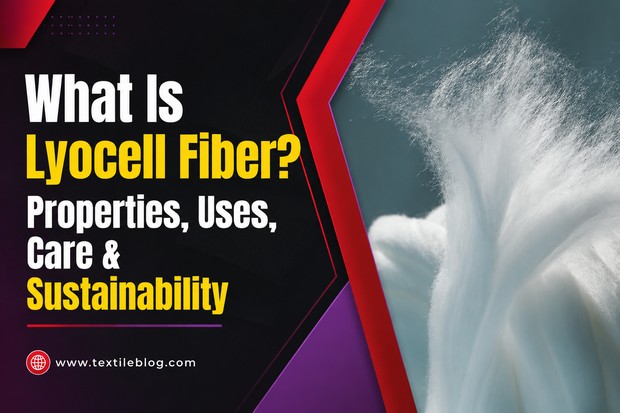
The name was derived from lyo, meaning solution, and cell, for cellulose. That name reflects the fact that the fiber is cellulose spun from a solution. Lyocell was the first new manufactured fiber to be developed in many years. The fiber is produced in Europe and the United States, and Lenzing AG, which makes Tencel®, manufactures fibers for higher-end apparel and home furnishings where the aesthetics of rayon, with added durability qualities, have appeal.
Tencel® has received a number of awards for its environmentally benign manufacturing process, including the ecolabel of the European Union.
Manufacture and Production
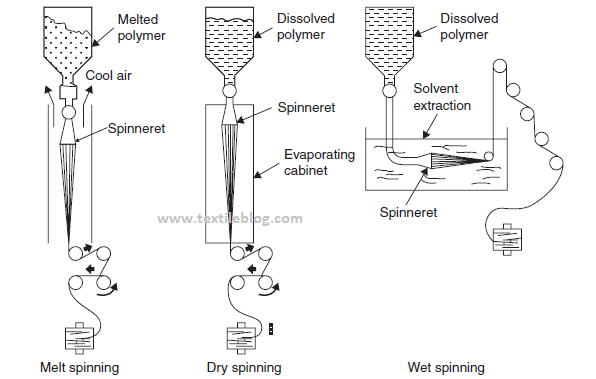
The raw material for lyocell, like that for viscose rayon, is dissolving pulp. The process is a form of wet spinning, often described as solvent spinning, where the cellulosic starting material is directly dissolved in an organic solvent and the fiber is regenerated from that solvent.
In this method, the cellulose polymer is dissolved in N-methylmorpholine oxide, or NMMO, an amine oxide with low toxicity and low skin irritation. When the mixture is heated, the cellulose dissolves directly, so there is no polymer degradation, as is necessary in the viscose process. The clear, viscous solution is filtered and then extruded through an air gap into a bath of dilute NMMO, where the cellulose is precipitated as a fiber. After spinning, the fiber is washed and dried, and the solvent is recovered, purified, and recycled.
A major advantage of this process is that it is self-contained. The solvent is not toxic, has low volatility during processing, and produces almost no harmful emissions. It is also reclaimed from the spinning bath and recycled. Because the solvent used to dissolve the cellulose is nontoxic and has actually been used in a number of cosmetic and hair products, lyocell is often billed as the “green” fiber.
Properties of Lyocell Fiber
Lyocell behaves much like rayon in chemical terms, but its structure gives it better mechanical performance. It has high moisture regain, is comfortable to wear, and dyes readily. At the same time, it has a different physical structure and better strength than rayon. The fabric also has good drape, even in heavy weights, and feels comfortable because of its high moisture absorbency.
Physical Structure and Aesthetics
Tencel® lyocell has a smooth cross section, without the serrations characteristic of viscose rayon. Lyocell does not collapse on itself the way rayon does, and it has a more rounded cross section and smoother longitudinal appearance. Because of the way the fibers form during spinning, they are highly crystalline, and small fibrils tend to splinter off from the surface. This fibrillation becomes more noticeable under wet abrasion, giving lyocell a fuzzy appearance and reducing the luster of the fibers.
That same tendency can also be turned into a design feature. The amount of fibrillation can be controlled by spinning processes and finishing treatments to create various surface textures. Wet fabric may be agitated and abraded, then sheared to produce a fine, even surface. The intensity of the treatment and the manner of shearing can be adjusted to produce a range of fabric surface textures. When controlled in this way, the finish gives the soft, peach-skin effect that is often described as “peach skin,” “mill wash,” or “soft touch.”
Lyocell fabrics with these finishes are made into shirts, jackets, and pants. The soft hand gives garments a casual look, and they have the added advantage over regular rayon of being machine washable. Lyocell can also be dyed in a wide range of colors.
As with all manufactured fibers, the aesthetics of lyocell can be varied significantly by changing the luster, length, and diameter. It is used by itself and blended with natural or manufactured fibers. Because it can fibrillate, or split lengthwise into tiny fibers, lyocell offers unusual combinations of strength, opacity, and absorbency.
Chemical Composition and Molecular Arrangement
Lyocell is 100% cellulose, with the same chemical composition and molecular structure as natural cellulose, but without the cell structure of the natural plant fibers. The polymer chain length is longer than that of rayon, but shorter than cotton. Drawing the fibers after spinning increases the orientation and crystallinity and makes lyocell more durable.
This is one reason lyocell ends up behaving more like cotton than other regenerated cellulose fibers. In practice, that gives it a useful middle ground between the softness of rayon and the durability expected in more demanding textile uses.
Mechanical Properties
Lyocell has high strength for a regenerated cellulosic fiber. It performs more like cotton than rayon, and its higher modulus makes it a good fiber for blending with cotton. Its tenacity is about 4.8 to 5.0 g/d dry and 4.2 to 4.6 g/d wet, with only about a 12 percent loss in strength when wet. That compares favorably with polyester, which can vary from 4.0 to 7.0 g/d when dry or wet.
Elongation is between that of regular rayon and HWM rayon. Dry breaking elongation is around 14 percent to 16 percent, and wet elongation is around 16 percent to 18 percent. Wrinkle recovery is better than rayon’s, and lyocell can be treated with wrinkle-resistant finishes without a severe loss of strength.
Lyocell also has moderate durability. It is the strongest of the cellulosic fibers, and its good wet strength gives it unusual possibilities for wet processing and finishing. Applications that require high wet strength are ideal for lyocell. Abrasion resistance is moderate, however, and wet abrasion will increase fibrillation. When abraded, the fibers may develop a fuzzy, hairy texture that can be distracting on smooth fabrics.
Comfort, Appearance, and Care
Comfort is one of lyocell’s biggest advantages. With a regain of 11.5 percent, static problems are not likely. The fiber is soft, smooth, and pleasant against the skin, which is why it works so well in apparel and interior textiles. It is especially useful for bed, bath, and table linens, as well as upholstery. As with other cellulosic fibers, thermal retention is poor, so it is chosen more for comfort and hand than for warmth.
Appearance retention is moderate. Lyocell will wrinkle, though not as severely as rayon, and its dimensional stability is good. It does shrink, but it does not show the progressive shrinkage seen in some rayon products. Its tendency to fibrillate with abrasion may create problems with fuzziness, pilling, or other surface changes over time. Elastic recovery is superior to rayon and acetate.
Easy-care performance is another clear benefit. Lyocell fabrics have good dimensional stability and moderately good wrinkle resistance, so they can be washed, although dry cleaning may be recommended for some items. Finishes can be applied to increase wrinkle recovery, and lyocell fabrics require less finish than cotton or rayon. Fabrics are usually given a finishing treatment to stabilize them so they will have low shrinkage, and this is especially important for bedding fabrics.
Laundering still needs some control. Fabrics rub against each other in the wash, and in the wet state this can increase fibrillation, altering the appearance and eventually reducing strength. Repeated washing can make the fibrillation worse and change the surface appearance. The severe conditions in commercial laundering may accelerate this effect. Dark or intensely colored lyocell fabrics may also show a decline in hand and irregular color after machine washing, so gentle agitation is the safer choice.
Lyocell is sensitive to acids and resistant to dilute alkalis and most organic solvents. Because of its cellulosic nature, it is also sensitive to damage by mildew and some insects.
Sustainability Facts of Lyocell
The development of lyocell in the early 1990s was prompted in part by concern with rayon’s sustainability. Lyocell is produced from wood pulp and spun into a solvent bath in a closed-loop manufacturing process that recovers and reprocesses 99.5 percent of the amine oxide solvent. That solvent is nontoxic and noncorrosive, and the chemicals used for lyocell production are significantly less hazardous to the environment than those used for viscose rayon.
Because the solvent is recycled efficiently and the wood is harvested from fast-growing eucalyptus trees raised for this end use, lyocell is more environmentally friendly than rayon and acetate. The cellulose of lyocell is biodegradable. If the fiber is placed in landfills, however, it will not degrade. Lyocell is not recycled. Like other cellulosic fibers, producing consumer goods from lyocell uses a large amount of water, dyes, and finishing chemicals. Depending on how items have been finished, they may require dry cleaning, and the solvents used in dry cleaning present additional environmental hazards.
Uses and Applications of Lyocell
Lyocell is used in men’s and women’s apparel such as shirts, blouses, pants, jackets, and dresses. It also appears in professional business wear, leotards, hosiery, casual wear, upholstery, window-treatment fabrics, and bed, bath, and table linens. Soft, denim-look shirts and pants are common uses when the peach-skin surface effect is desired.
Household linens are a growing market for lyocell. Sheets, comforter covers, and pillowcases are often made from fine yarns, allowing for a higher thread count. These are luxury items, in part because lyocell is more expensive per pound than viscose rayon and other fibers. Nonfibrillating versions of Tencel® are available, and they give the smoother fabric hand desired for household linens. Lower-fibrillating lyocell fibers are also used in knits, where the looser fabric structure helps them retain their original appearance better.
The fiber blends well with cotton, wool, linen, silk, nylon, polyester, and other manufactured fibers. Lyocell was originally used mainly in fairly tightly woven structures to inhibit fibrillation. New versions have been produced by crosslinking the fibers as they are spun to control fibrillation, and that has opened the door to a much wider range of knits.
Lyocell is also used in technical and industrial products. In manufacturing of glass and other items, it is used in conveyor belts because of its strength and softness. In fibrillated form, it is used for filters, printers’ blankets, specialty papers, lens polishing cloth, and medical dressings.
Types and Variations of Lyocell Fiber
Because lyocell is a relatively new fiber, there are fewer modifications available for it than for many other manufactured fibers. As the fiber gains market share, more modifications are expected. Current modifications related to fiber size and length enable it to be blended with other fibers.
Tencel is a trade name used to promote lyocell, and a micro lyocell version is available under the trade name MicroTencel.
Closing Thoughts
Lyocell stands out because it brings together rayon-like aesthetics, strong wet and dry performance, and a manufacturing process that is more tightly controlled than older regenerated cellulosics. Its soft hand, good drape, and ability to take a range of finishes have made it useful in apparel, home textiles, and selected technical products. The same fibrillation that gives it a peach-skin feel can also create care issues, so finishing and laundering still matter. As demand continues to favor comfort, durability, and cleaner processing, lyocell has room to keep expanding into new textile applications.