Last Updated on 14/03/2026 by textileblog
What Are Polypropylene (PP) Fibres?
Polypropylene (PP) fibre is often seen as the ‘workhorse’ of synthetic fibres, especially in large-scale industrial use. Despite its low cost, it has high strength, toughness, and good resistance to chemical attack, which make it reliable in demanding conditions. As a result, it is used in many applications, from sacks and large industrial bags to medical products that need clean, durable materials. A major drawback is that PP fibre, like all polyolefin fibres, cannot be dyed unless modified with suitable additives, so colour choice is limited without treatment.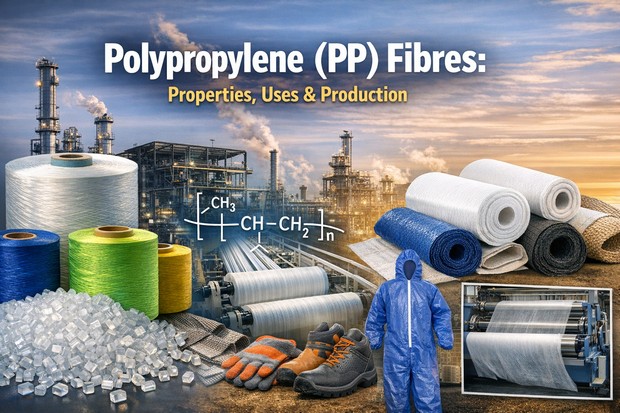
The commercial use of PP fibre grew in the 1960s, when it began to replace jute in carpet backings and bast fibres in rope, mainly because it was cheaper and more consistent. Recent estimates place yearly world production of polypropylene fibres for textiles at about 5 million tonnes. Polyester remains far higher at well over 60 million tonnes a year, while polyamide fibre is also produced on a multi-million-tonne scale, showing PP’s strong place in the market. PP accounts for over 90% of polyolefin fibre production, so it clearly dominates this fibre group.
How Polypropylene Is Produced
PP is produced by polymerisation of propene, also called propylene, which is made as a by-product of oil cracking and from the fractionation of natural gas, both common petrochemical sources. Natural gas is a mixture of different gases, and fractionation means separating and collecting them for industrial use. Propene is generally polymerised by a process developed by Giulio Natta in 1954, after a similar process for producing polyethylene was invented by Karl Ziegler the year before. The process uses special catalysts called Ziegler–Natta catalysts, which contain titanium chloride, or sometimes vanadium chloride, and an organometallic compound of aluminium and a hydrocarbon. These help the chains form in a controlled way. More recently, alternative catalysts called metallocenes have been developed, giving producers another route for PP manufacture. These catalysts, often based on zirconium, are more active and selective than Ziegler–Natta catalysts, and they give better control over the structure of the PP chains produced, which is important for fibre performance. As a result, filaments made from metallocene PPs have better mechanical properties, such as strength and toughness. However, metallocene catalysts are much more expensive than Ziegler–Natta catalysts, which limits wider use.
How PP Fibres Are Made
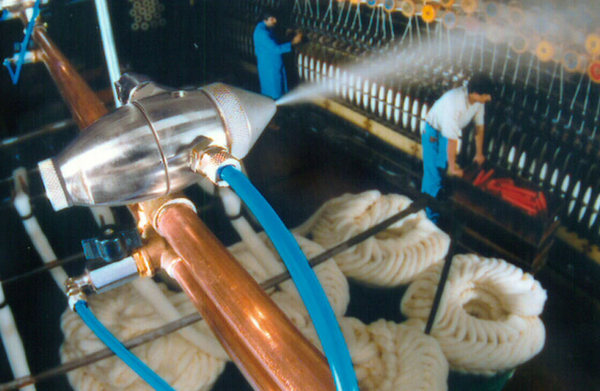
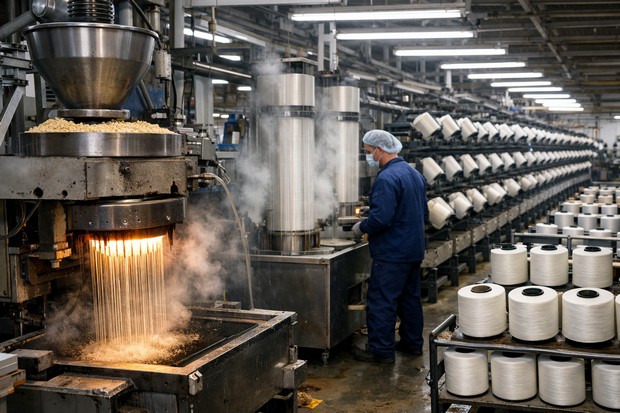
Polypropylene fibres are produced by melt extrusion of PP granules, in which the polymer is melted and pushed through small holes. Several melt extrusion processes are used, depending on plant design and product needs. The choice of process depends on the type of fibre needed and its end use. Different processes are used to produce multifilament yarns, monofilament yarns, staple fibres, tapes, and non-wovens, each suited to a different end product. These are described briefly below.
PP multifilament yarns are produced in several forms: partially oriented yarns (POY), fully oriented yarns (FOY), and bulked continuous filament (BCF), which serve different processing needs.
- The POY process is low in cost, which makes it useful for large-volume production.
- It also allows greater flexibility in later processing, such as drawing, twisting, and texturing, because the yarn is not fully finished at this stage.
- POY yarns are generally produced with linear densities of 40–200 dtex, while each filament usually has a linear density of 0.5–4.0 dtex.
- A key feature of the POY process is the long cooling unit through which the filaments pass after melt extrusion from the spinneret, so they can solidify properly.
- The cooling unit can be up to 10 m long so that, at high production speeds, the filaments cool enough before they are wound together as multifilament yarn. This helps prevent sticking and distortion.
- Winding speeds are usually 2000–3000 m/min.
- The POY yarns are then processed further by drawing and, in some cases, twisting and texturing, to develop their final properties.
- In the production of FOY yarn, spinning and drawing are consecutive parts of one continuous process, which reduces handling.
- The FOY process is very flexible, and depending on the control settings and the grade of PP, it can produce yarns with a wide range of mechanical properties, from standard to high-performance types.
- Final winding speeds can reach 5000 m/min.
- The FOY process can produce both high-strength yarns, with linear densities of 5–10 dtex per filament for technical fabrics, and standard yarns, with linear densities of 1–2 dtex per filament, for more traditional uses.
- FOY yarns are generally stronger than yarns produced by the POY process, even after POY yarns have been drawn, because orientation is developed more fully during manufacture.
- The BCF process, or bulked continuous filament process, combines spinning, drawing, and texturing in one process, which improves production efficiency.
- Filament production speeds are 1500–4000 m/min, depending on the product being made.
- It is similar to the FOY process, except that the filaments are textured after drawing, to give more bulk and softness.
Types of PP Yarns
Monofilament Yarns
PP monofilaments have linear densities above 100 dtex and are much coarser than multifilaments, so they act as single, thicker strands. Monofilaments made by the same methods used for multifilaments tend to curl and are therefore unsuitable for many applications, especially where straightness is important. Instead, PP monofilaments are usually formed at lower speeds and extruded into water for more effective cooling, which helps control their shape. After leaving the spinneret, the monofilament travels through less than 5 cm of air before entering a water bath, so cooling begins almost at once. Later drawing may involve as many as three stages at raised temperatures, typically 80–90 °C, to improve strength and chain orientation. PP monofilaments are made for high-strength uses such as belts, ropes, and hawsers used for mooring and towing ships, where durability under load is essential.
Staple Fibres
Staple fibres can be produced by two methods: a two-stage discontinuous process or a single-stage compact continuous process, depending on fibre quality and output needs. The two-stage process is used for very fine, high-quality staple fibre, about 0.5 dtex per fibre, and the spinning speed is typically about 2000 m/min. The spun filaments from the first stage move to the second stage, which includes drawing, crimping, and cutting them into staple fibres of the required length, so they can be processed like natural staple fibres. An alternative to cutting is converting, in which a sliver of parallel fibres is formed, ready for further spinning. These fibres are then used for worsted spinning, a method used to make smooth, even yarns. A disadvantage of the two-stage process is the large amount of space needed for the equipment, which can raise plant costs. In particular, the cooling zone is very long because the filaments must cool evenly. However, each stage can be run independently under its own best conditions, allowing better process control.
The single-stage compact process combines all the production stages and is now considered more economical for small quantities of staple fibre, especially where compact equipment is preferred. Although the spinning speeds are low, at 100–300 m/min, productivity is increased by using spinnerets with up to 100,000 holes arranged in a grid, so many filaments are formed at once. The filaments produced in the spinning stage are combined into a tow, which is fed continuously into a drawing unit. The fibres produced have a minimum linear density of 1–3 dtex and are used for carpet yarns and non-woven products, where medium-fine fibres are suitable.
Non-Wovens and Tapes
Non-Wovens
PP non-wovens can be produced by a multistage process that includes the production of staple fibres, if staple-based webs are needed. More often, a single-stage process is used that combines filament production with the formation of a non-woven fabric, which saves time and handling. The web that forms the fabric is usually held together by thermal bonding because PP fibres have a low melting point of 160–165 °C, which allows efficient heat bonding. A thermally bonded non-woven fabric is made of fibres containing heat-sensitive material, such as PP, that are bonded by heat, without traditional weaving or knitting.
There are two important forms of the single-stage process: the spun-bond process and the melt-blown process, both widely used in industry. In the spun-bond process, the non-woven fabric consists of a web of randomly distributed, thermally bonded filaments, giving a strong and stable sheet. Spun-bonded PP webs are known for their strength, which is useful in durable disposable products. In the melt-blown process, PP is extruded through many small spinneret holes placed close together, to form very fine streams. Just below the spinneret holes, the molten polymer stream is caught in a fast current of hot air and broken into a network of very fine entangled fibres, which greatly increases surface area. These fibres are immediately deposited onto a moving conveyor belt, where the web is formed. Although melt-blown non-wovens are weaker than spun-bonded webs, their texture makes them suitable for applications where filtration or absorption is important, such as hygiene and filter products.
Production lines that combine both processes are used to form SMS multilayer fabrics, meaning spun-bonded, melt-blown, spun-bonded, which combine the useful properties of both materials in one layered structure. The outer spun-bonded layers provide good mechanical properties, while the inner melt-blown web provides good filtration and absorption. SMS fabrics are widely used in disposable hygiene and medical products, where cleanliness and barrier performance matter.
Tapes
PP is often processed into tapes because the polymer can be slit or shaped easily. These tapes are used mainly in household products such as carpets and in technical textile products such as sacks, industrial bags, and tarpaulins, where low weight and strength are useful. PP tapes have also been used in sunhats, handbags, and beach shoes, showing their versatility in consumer goods.
There are two main methods for producing tapes, each suited to different cost and quality needs. In the more common method, a PP film is extruded and then cooled in a water bath or on rollers, to set its shape. The film is then stretched in one direction to about 10 times its original length and cut with knives into tapes, which increases orientation and strength. Alternatively, if it is stretched enough, the film begins to split on its own, reducing the need for cutting.
In the other method, each tape is melt extruded separately through its own slit-shaped orifice, giving closer control over tape form. This process is much more expensive and is generally limited to tapes for specialist uses, such as medical applications, where higher precision may be required.
Spin Finish in PP Fibres
Like other synthetic fibres, PP filaments are treated with a spin finish to protect their surfaces and reduce static electricity during processing, which helps stable running on machinery. Static electricity can cause ballooning in multifilament yarns and may also distort or break the yarn during processing, particularly at high speeds. It can also cause electric shocks when processing equipment is touched, creating a safety and comfort issue. Static electricity may also build up on the finished garment and cause it to cling to the body or to another garment, which reduces wearer comfort. It can be discharged when the wearer touches a conducting material, usually metal, producing a small spark. As a result, the wearer may feel discomfort, even if the effect is brief.
Another function of a spin finish is to reduce friction during fibre processing, which becomes more important as speeds increase. The heat created by friction can cause the fibres to soften or even melt, damaging product quality. The spin finish may contain an antimicrobial agent to kill or stop micro-organisms, although polypropylene fibres are themselves quite resistant to them.
PP fibres are highly hydrophobic, meaning they repel water very effectively, more than many common textile fibres. To allow for this property, special wetting agents must also be included in the finish formulation, so the finish can spread evenly across the fibre. In addition, some components of spin finishes commonly used for other synthetic fibres cannot be used on PP fibres because they move into the fibres and cause swelling, which can alter fibre performance. A spin finish contains a complex mixture of chemical components and is often applied as an emulsion, to give even surface coverage.
Additives Used in PP Fibres
Additives are used to help process PP fibres and to achieve the required fibre properties, both during manufacture and in use. They are either present in the PP granules supplied to the fibre producer or added to the PP melt before extrusion, depending on the production route.
Additives have several roles, and each role affects final performance. Some act as heat stabilisers to prevent thermal breakdown of the polymer chains during fibre processing, when the material is exposed to high temperatures. Others act as stabilisers against light, especially ultraviolet radiation, during end use, or as flame retardants to prevent the fibres from catching fire, which improves service safety. Antistatic additives are also likely to be present, to reduce charge build-up.
Because commercially produced PP fibres contain several additives with different functions, care must be taken to ensure that one additive does not reduce the effectiveness of another, which can happen in mixed systems. In some cases, there may be helpful combined effects in which one additive supports the action of another, improving overall performance. All additives must also be able to withstand fibre-processing conditions, the processes used to convert the fibre into the finished product, and the end use of the product throughout its lifetime, without failing early. Specific additive packages are still being developed and must be carefully assessed for unwanted effects during fabric manufacture and end use, before wide adoption.
Structure of PP Fibres
The structure of a fibre can be considered at several levels, from molecules to visible form. At the molecular level, the structure of the individual polymer chains is important because it affects basic behaviour. At a larger scale, the way these chains are arranged within the fibre is also important, especially for strength and stiffness. The appearance of the fibre is another factor, including fibre size and cross-section, which can influence feel and use.
Chemically, PP has a carbon main chain with methyl side groups, and the placement of these groups matters. PP chains can adopt several molecular arrangements, which are important for fibre behaviour. In stretched-out views of isotactic PP chains, all the methyl side groups, –CH3, attached to the main chain are positioned on the same side of the chain, giving a regular layout. In practice, however, the chains are not straight but usually take a three-dimensional helical form, which is more realistic for solid PP. The isotactic form is used in commercial PP fibres because its highly regular structure gives better mechanical properties, especially strength and stiffness. In syndiotactic PP, the methyl groups alternate from one side of the chain to the other, forming a different regular arrangement. These chains also take a helical form, rather than remaining flat. In atactic PP, the methyl groups are arranged randomly on the two sides of the chain, so the structure is less ordered.
The arrangement of chains within a fibre can be complex and is strongly affected by fibre-processing conditions, such as cooling and drawing. At the simplest level, a fibre contains crystalline regions, where polymer chain segments are arranged in clear lattice structures, and amorphous regions, where the chains are arranged more randomly. A single polymer chain may form part of more than one crystalline region, thus providing continuity along the length of the fibre, which helps carry stress. However, this picture is too simple in practice because several intermediate degrees of chain organisation are also likely to be present between these two extremes.
Three distinct crystalline forms of PP are known: α, β, and γ, each with a different internal arrangement. The α form is the most stable and the most important for PP fibres. The α structure contains both left-handed and right-handed helical forms, and each helix lies mostly next to helices of the opposite handedness, which helps define the crystal structure. A para-crystalline form is also known, in which there is some chain order along the length of the fibre but not across it, so the ordering is only partial.
Although many PP fibres are extruded with a circular cross-section, the filaments have a waxy feel, which may be undesirable, especially in touch-sensitive products. However, this feel can be reduced or almost removed in filaments with some non-circular cross-sections, including triangular, multilobal, and cross-shaped forms, because their surfaces interact differently. Hollow filaments are also produced commercially, often to lower weight and increase bulk. Melt extrusion of such filaments requires more complex spinneret-hole shapes, which makes processing more demanding.
Other properties affected by cross-sectional profile include bulk, ability to provide heat insulation, resilience, and degree of soiling, all of which matter in final products. For example, fibres with more unusual cross-sectional shapes often pack more loosely than fibres with circular cross-sections, trapping more air between them. As a result, fibre bulk increases and insulation improves, which can improve comfort and warmth.
Properties of PP Fibres
Like other synthetic fibres, the properties of PP fibres are influenced by several factors, so performance can vary widely:
- The grade of PP used to make the fibre, which sets the starting polymer quality.
- Fibre-processing conditions, which affect orientation and structure.
- The additives present, which can improve stability or safety.
Polypropylene fibres are, in most cases, highly resistant to chemical attack by acids, alkalis, and most organic liquids, which makes them useful in harsh environments. The fibres are swollen by some organic liquids at raised temperatures and may even dissolve in them if the temperature is high enough, so hot solvent exposure must be controlled. The fibres are also affected by strong oxidising agents such as hydrogen peroxide, which can reduce fibre strength and cause discolouration, especially after prolonged contact. In addition, polypropylene fibres are weakened by ultraviolet radiation, so commercial PP fibres contain light stabilisers, particularly for outdoor use. The fibres are not broken down by micro-organisms, which helps long-term durability.
Uses of PP Fibres
PP fibres have a wide range of applications across both everyday and technical products. One reason is that, for a fibre that is inexpensive to produce, its technical performance is very good, offering good value for manufacturers. In addition, the production of PP fibres is comparatively simple, which supports large-scale manufacture. However, because PP fibres cannot be dyed easily, their use in clothing is much more limited, especially in fashion items that need many colours.
PP fibres are, however, finding several applications in sportswear and activewear, such as walking socks, cycle shorts, swimwear, diving suits, and lightweight clothing for climbers, where low weight and moisture transfer are valued. Because PP fibres absorb almost no moisture yet move water very easily, sweat from the body is not absorbed but carried to an absorbent outer layer, supporting effective moisture management. PP garments therefore feel very comfortable next to the skin, particularly during active use. In addition, good thermal insulation is retained because the fibres do not become wet, so the wearer stays warmer.
Conclusion
Polypropylene (PP) fibres are low-cost, strong, lightweight, and resistant to many chemicals, making them important in ropes, non-wovens, tapes, medical products, and technical textiles. Their easy processing and good moisture management add to their value. Although poor dyeability remains a limitation, additives and controlled manufacturing help polypropylene fibres meet many industrial and consumer needs.
References
[1] Ashford, B. (2016). Fibres to Fabrics. AuthorHouse.
[2] Kolanjikombil, M. (2018). The Substrates: Fibres, Yarn and Fabric. Woodhead Publishing.
[3] Veit, D. (2023). Fibers: History, Production, Properties, Market. Springer Nature.
[4] Sinclair, R. (2014). Textiles and Fashion: Materials, Design and Technology. Woodhead Publishing.
[5] Mülhaupt, R. (2016). Ziegler–Natta Catalysis and Propylene Polymerization. Springer.
[6] Jambrich, M., & Hodul, P. (2015). Textile Applications of Polypropylene Fibers. Springer.