From firefighter turnout gear to tire cords and aerospace composites, aramid fibers appear in products where strength, heat resistance, and low weight matter. These fibers were engineered for demanding conditions, and that is why they are used in protective apparel and technical products. The type of aramid makes a major difference in performance, especially when comparing meta-aramid and para-aramid fibers. Their manufacture and end uses follow from that difference.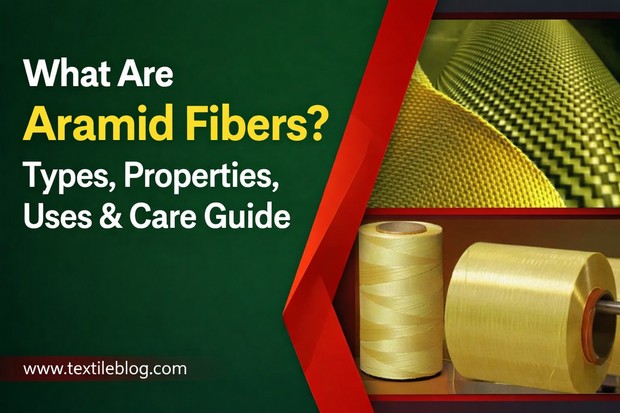
What Is Aramid Fiber?
Aramid, a manufactured fiber in which the fiber-forming substance is a long-chain synthetic polyamide in which at least 85 percent of the amide linkages are attached directly to two aromatic rings. Aromatic rings have six carbon atoms linked together in a hexagonal structure; they add stiffness when incorporated into polymer chains. For aramids the rings can be linked through the carbons at different positions on the ring. If the linkages are two carbons apart, the polymer is a meta-aramid, whereas in para-aramids, the linkages are three carbons apart.
The aromatic rings make the aramid polymers stiff and inflexible, putting them in a class of polymers known as rigid rod polymers. This terminology describes the behavior of such polymers in melts or solutions where they will form regions of parallel chains rather than entangle or fold, like the polymers in commonly used fibers.
Nylon is a polyamide fiber; aramid is an aromatic polyamide fiber. DuPont chemist Stephanie Kwolek developed a nylon variant with exceptional heat and flame resistance. It was introduced in 1963 under the trade name Nomex®. DuPont introduced another variant in 1973 as Kevlar®. Aramid has exceptional strength in addition to fire resistance. The Federal Trade Commission established the generic classification of aramid in 1974. DuPont produces the meta-aramid Nomex® and the para-substituted aramid Kevlar®. The Japanese company Teijin manufactures Twaron®, a para-aramid, and Teijinconex®, a meta-aramid fiber.
How Aramid Fibers Are Made
Because aramid polymers have such high melting points, they are made by a different process than other synthetics that are heated to effect polymerization. Instead of acids, the more reactive acid chlorides are used so the polymers can be formed in solution at much lower temperatures.
The polymer for Nomex® is dissolved in dimethyl formamide, dry spun, then drawn to produce an extremely crystalline fiber. The para-aramid for Kevlar® fibers is dissolved in sulfuric acid and spun using the dry-jet wet spinning method. During the spinning process, the rigid polymers form liquid crystals. As rigid rods, they become aligned in the direction of the fiber axis, but are still able to slide past each other. The fibers are stretched as they leave the spinneret and enter the air gap, then the coagulation bath. The drawing completes the very high degree of orientation and crystallinity in the fibers.
Key Properties of Aramid Fibers
Aramid can be wet- or dry-spun and is usually round or dog-bone shaped. Aramid has high tenacity and high resistance to stretch and to high temperatures. It maintains its shape and form at high temperatures. Its resistance to most chemicals is good to excellent. It is only moderately resistant to sunlight. Aramids are oleophilic and prone to static buildup unless finished. Aramid fibers have excellent impact and abrasion resistance.
Meta-Aramid Fibers
The strength of meta-aramid fibers is much less, around five g/d; they also have a lower modulus, making them less stiff. Nomex® is a normal tenacity meta-aramid, or m-aramid, with a lower specific gravity and heat resistance and a higher regain compared to Kevlar®, which is a high-tenacity para-aramid, or p-aramid.
Meta-aramid fibers are usually peanut shaped in cross section. The color range of aramid fibers was originally fairly limited, but meta-aramids are now available in a number of colors, including bright fluorescents for added safety protection.
Para-Aramid Fibers
Para-aramid fibers have extremely high modulus and tenacity because of the liquid crystalline stage that occurs during spinning. Tenacity can range from twenty-two to twenty-eight g/d, compared to less than ten g/d for even the highest-strength nylon fibers. The strength of para-aramid fibers makes them extremely tough fibers for specialty products.
Para-aramid fibers have a rounder cross section. The color range for para-aramid fibers is more limited, generally being restricted to gold, sage green, royal blue, and black.
Moisture regain of aramids is 5 percent, a moderate degree of absorbency. The more crystalline para-aramids have lower regain. Aramid fibers have no melting point because they decompose before melting, and they have extremely low combustibility. The fibers decompose at a temperature above 700°F, and meta-aramid fibers decompose at a slightly higher temperature. This property determines their use in fire-resistant garments. The lower-modulus meta-aramids are more comfortable in these garments, but they are often reinforced with a small amount of a para-aramid fiber, which retains better char strength after burning.
Aramids degrade and lose strength on exposure to ultraviolet rays. Their resistance to radiation from gamma, beta, and X-rays is, however, excellent, and this resistance is utilized for some industrial applications. Their resistance to most chemicals and organic solvents is generally good, but like nylons, they are degraded by strong acids. Aramids are difficult to dye and have poor resistance to acids. Solution-dyed aramids are more common; aramid can be dyed intense colors for high-visibility protective apparel.
Where Aramid Fibers Are Used
Meta-Aramid Uses
Metaaramids, with their excellent thermal stability, are fabricated into clothing for firefighters, race car drivers, petrochemical and refinery workers, power and utility workers, military flight personnel, and astronauts. Fabrics are used in a wide variety of garments, including hoods, shirts, lab coats, jackets, parkas, aprons, gloves, pants, coveralls, jumpsuits, and socks. The fiber’s light weight, lower modulus, and moderate absorbency make it more comfortable than other materials that might be used. Highly temperature-resistant papers are also made from meta-aramid fibers.
Nomex® is softer and more comfortable in daily-use garments compared to Kevlar®. Sometimes, both Nomex® and Kevlar® are used in apparel where high strength and comfort are required. Nomex Omega® by DuPont includes an expanding air layer that insulates firefighters from heat.
Para-Aramid Uses
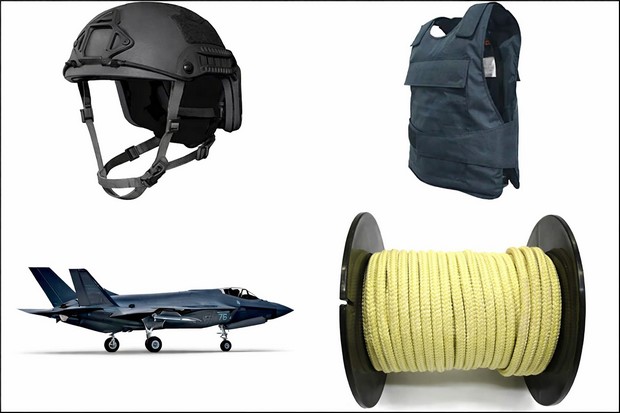
Kevlar®, with its high strength and modulus, is used in protective apparel such as safety gloves, boots, clothing, chain saw chaps, and bullet-resistant vests. They can also be seen as reinforcing fibers in helmets and building structures and have replaced glass fiber in some aircraft because they are lighter in weight than glass. Another use is as protective covers in fiber-optic cables. The toughness of para-aramids is an advantage in these products where impact resistance and ability to absorb energy are important.
Sports equipment, such as boats, hockey sticks, tennis racquets, fishing rods, and golf clubs, make use of para-aramid fibers as well. The advantage here is the light weight of the aramid fiber compared to other reinforcing fibers such as carbon or glass. Para-aramids are also used in tire cords, ropes, cables, industrial belts and hoses, and sailcloth. Strength and light weight are again important here, while the fiber has the added advantage of good resistance to creep, so line, ties, and sails stay taut.
Hollow aramid fibers produce fresh water from sea water through reverse osmosis. The fiber’s thin, dense skin allows only water to pass through. Aramids are used in mechanical rubber goods, marine and sporting goods, and structural composites for boats and aircraft. Composites of aramid fibers intermixed in resins are used in civil-engineering structures like bridges and elevated highway-support structures. Aramids are expensive fibers, though, so they are limited to uses where their specific advantages in terms of strength, impact resistance, and/or fire resistance are vital.
How to Care for Aramid Garments
With increased usage of aramid fibers in protective clothing, consumers and professional launderers and dry cleaners are encountering garments made from these fibers. Aramid garments can be machine washed and dried when laundered at home, but they must be washed separately so they do not pick up lint from other garments. The lint will impair their flame resistance. Garments soiled with grease or oil can be dry-cleaned. Chlorine bleach should not be used, but oxygen bleaches are safe.
Conclusion
Aramid fibers sit in a narrow but important space between heat resistance, strength, and low weight. Meta-aramids are valued where comfort and thermal stability matter, while para-aramids are chosen for high strength, modulus, and toughness. That is why they appear in protective clothing, technical papers, ropes, cables, composites, and reinforcement products. As performance demands continue to rise, aramids will remain a practical choice wherever standard synthetics fall short.