Introduction
Tire cords are embedded in the rubber matrix to reinforce it. Tire cords are manufactured to exhibit specific properties, and selection of fiber and yarn features is important in providing optimum performance. As the summary discussion of the effects of yarn structure on fabric performance indicates, the selection of textiles with particular end uses must take into account the properties contributed by the various components of the structure. In the tire industry, the term ply is used not only in its conventional textile meaning, but also to refer to the adhesive sheet in which the tire cords are embedded. Sheets of steel fibers are called belts.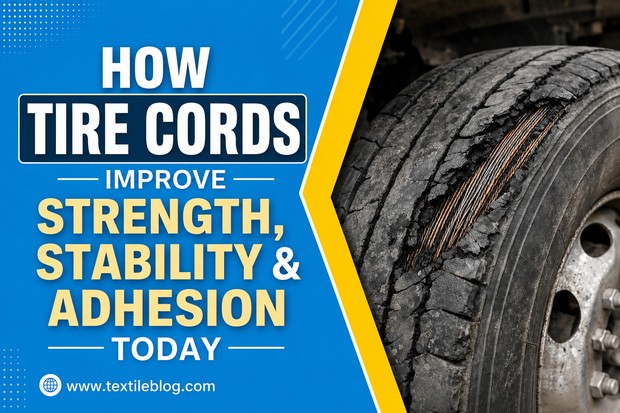
Tensile Properties
Strength
Perhaps the most important property one thinks of for tire cords is strength. Cords in tires are embedded in the rubber matrix to reinforce it. The force-bearing ability of a reinforced rubber product is related to the strength of the yarn or cord used as a reinforcing material. In most tires currently produced, both manufactured fiber and steel cords are used. Steel is known for its strength, but it is also heavier than synthetic fibers. Therefore, tires are not reinforced with steel cords alone, but also with high-tenacity polyester, nylon, rayon, or aramid fibers. The steel belts are placed parallel to the tread, so they can aid in bearing the load as the tire turns. The textile fiber cord plies are perpendicular to the tread. Polyester, nylon, and rayon are the most commonly used nonsteel fibers, and a number of fiber manufacturers make versions of these fibers specifically for tire cords. The extremely high-strength fibers such as aramid or PBO are not used in passenger or light truck tires, primarily because of cost.
Modulus, Elongation, and Dimensional Stability
Two other tensile properties, modulus and elongation, are also important in tire performance. Higher-modulus fibers, which resist initial tensile forces better, are preferred. This is one reason many tire producers have replaced nylon with polyester in the body of most tires. Tire cords should also resist elongation and deformation so they are dimensionally stable. When a car is parked for some time, tires with nylon cord reinforcement may flatten slightly where the tire contacts the road surface. When the car is driven again, this flat spot will initially make for a bumpy ride until the tire warms up and resumes its round shape. Polyesters are more dimensionally stable, and several companies make high-modulus, high-tenacity polyester fibers specifically for tire cords.
In some standard passenger and light truck tires and in high-performance tires for high-speed vehicles, however, nylon cap plies are placed over the steel belts. The nylon cap plies have higher shrinkage than polyester at high running temperatures and will pull down over the steel belts. This belt section of the tire is then better able to withstand the radial forces and high temperatures generated at high speeds. In regard to overall body cord strength, or carcass strength, for load carrying capacity, larger passenger and light truck tires are designed with two body plies to support the higher vehicle loads, whereas most smaller standard vehicles, which bear smaller loads, tend to use smaller tires designed with only one body ply, or monoply tires.
Yarn Structure, Twist, and Cord Size
The yarn structure and type are also selected to maximize the strength of tire cords. As the name implies, a cord structure is best because it is stronger than single-yarn structures. The yarns are ply twisted; then the plies are twisted to form a cord. In most passenger and light truck tires, two-ply yarns are typically used, and in some cases, for extra-load tires, three-ply yarns are used, where two body plies of two-ply yarn are not appropriate for load or tire handling properties. The yarn ply structure will also affect the flat spot performance of the tire. Two-ply yarn nylon cap plies are typically used for most passenger tires; however, one-yarn ply of nylon is becoming increasingly popular for some cap plies to improve the flat spotting condition of the tire.
The yarn twist level will also affect the quality of the tire cord. All tire cords are made from filament yarns, which are much stronger than staple yarns. The yarns are twisted to increase strength. Tire cord twist levels are optimized for the best combination of tensile strength and cord fatigue, that is, best retained tensile strength over the life of the tire cord. Size affects strength as well, and tire cords are large, often five hundred tex and greater, compared to most yarns used for apparel or home furnishings. It is not desirable, however, to use very large yarns because the surface area for bonding to the rubber will be decreased.
Linear Density
The weight per length, or linear density, of fibers used in tire cords affects the weight of the tire. This precludes reinforcement of tires entirely with steel cords. Steel fibers have a specific gravity of about 7.8, more than five times that of polyester and nylon. Nylon has a slightly lower density than polyester, which might be a slight advantage.
Adhesion
Because tire cords are used to make rubber tires stronger and more resistant to force, it is important for the cords to adhere to the rubber. Good adhesion results in better transmission of the applied forces to the reinforcing material, in this case the steel or manufactured fiber cords. Textile tire cords have an advantage over steel because they have a larger surface area for bonding. In common manufacturing processes, the textile cords are woven into a sheet and dipped into an adhesive, then heated under tension to set their cord properties to specified tensile, elongation, modulus, and shrinkage levels. A good coating of the fibers by the adhesive helps to stabilize them and decrease elongation. The rougher surface of the twisted and/or plied filament fibers increases the penetration and pickup of the adhesive, which is usually a latex, or water emulsion.
Conclusion
Tire cord performance depends on a careful balance of strength, modulus, elongation, linear density, and adhesion. Steel is known for its strength, but it is also heavier than synthetic fibers, so manufactured fiber cords continue to play an important role in tire reinforcement. Yarn structure, twist level, and ply arrangement all affect load carrying capacity, flat spot performance, and retained strength over the life of the tire cord. When these factors are selected well, the cord can reinforce the rubber effectively and keep the tire stable under service conditions. This is why tire cord design remains a careful materials choice in tire construction.