Eyelets and grommets are commonly used to reinforce textile openings and help prevent fraying, stretching and tearing. Although the terms are sometimes used interchangeably, the components can differ in construction, scale and load capacity.
Both appear across garments, footwear, bags and accessories, but the correct choice depends on the fabric, opening size, applied tension, appearance and available setting equipment.
Understanding these variables helps product-development and production teams avoid loose hardware, distorted holes and premature fabric failure.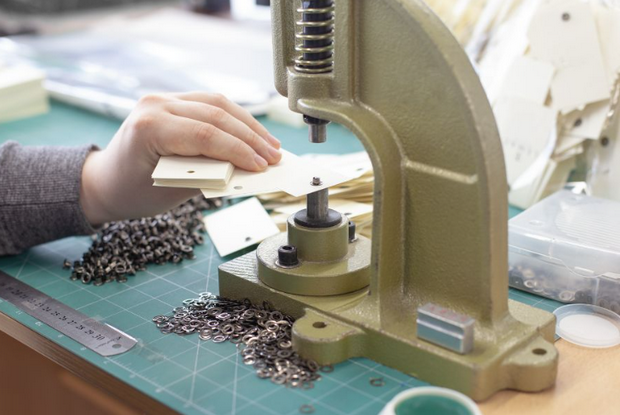
What Are the Main Differences Between Eyelets and Grommets?
Both components reinforce a hole in fabric, but eyelets are generally smaller and suited to light-duty or decorative applications. Grommets are typically larger and often pair a ring with a separate washer, making them better for heavier materials and repeated tension.
Actual terminology varies by supplier, so specifications should confirm the full construction rather than relying on the name alone.
Construction, Size and Profile
An eyelet commonly has a compact, one-piece barrel that rolls or flares against the reverse of the material. A grommet more often combines a larger front ring with a washer, capturing the textile between two parts and creating a broader bearing surface.
Eyelets therefore tend to create a discreet, low-profile finish, while grommets have a heavier visual and structural presence. The final profile can be adapted further through customisation, with some manufacturers of apparel eyelets offering different sizes and washer configurations to suit the fabric thickness and intended use.
Fabrics and Common Applications
Eyelets are frequently used in cotton, reinforced knitwear and thin leather for hoodie drawcords, ventilation, lacing and decorative details. Their smaller diameter can suit areas where visual restraint matters.
Grommets are more common in denim, canvas, vinyl, heavy leather, workwear and bags, particularly where cord, rope or webbing places significant stress on the opening. Beyond apparel, heavy-duty grommets reinforce openings in curtains, tarps, tents and sails.
These are practical tendencies, not absolute rules; a reinforced lightweight textile may accept a small grommet, while a decorative heavy garment may use a carefully supported eyelet.
Durability and Stress Resistance
Eyelets generally perform well in light- to medium-duty openings when their barrel length, setting pressure and backing are correct. For higher or repeated loads, a grommet washer spreads pressure over a wider area, reducing stress concentration at the cut edge.
Neither component can compensate for unsuitable fabric preparation. Interlining, reinforcement patches or bonded layers may be required to prevent stretching and pull-through.
Development testing should assess both the metal or plastic hardware and the complete assembly, because failure often begins in the textile surrounding the hole.
How Should Manufacturers Choose Between Eyelets and Grommets?
When choosing between eyelets and grommets, manufacturers should compare the expected load, fabric weight, required opening diameter, appearance, unit cost and setting process. Eyelets are usually the practical choice for lightweight, lower-stress or aesthetic apparel details. Grommets are preferable for structural openings exposed to strong or repeated tension.
Expected Stress and Intended Use
The selection should begin with the forces the opening will face during normal wear and care. A fashion drawcord exit or decorative lacing point may need only a well-set eyelet.
A bag closure, workwear ventilation point or opening carrying rope is more likely to benefit from a grommet. When tension changes direction repeatedly, the washer helps distribute pressure and limits local movement.
The assessment should also account for laundering, repeated cord abrasion and changing load directions rather than considering appearance alone.
Fabric Weight and Component Size
Hardware size must be matched to the textile stack, not selected from diameter alone. Lightweight fabrics usually require a smaller eyelet and controlled pressure to avoid puckering or cutting.
Thick fabrics need a barrel long enough to roll securely through all layers, with stronger reinforcement where necessary. The inner diameter should provide clearance for the cord, lace or rope without excessive movement. Sampling on the final fabric, interlining and finish is essential because coatings and multiple plies alter effective thickness.
Appearance and Finish
Eyelets provide a compact, discreet finish alongside drawcords, labels or decorative stitching. Grommets create a bolder industrial detail and, with the correct washer, can look finished on both sides. Designers should specify visible diameter, profile, shape, colour and plating rather than choosing from a catalogue image alone.
Matte, polished, antique and painted finishes can behave differently during setting and laundering, so approved samples should represent the production finish.
Installation Method and Equipment
Small development quantities may be set with pliers, a hand setter or matched dies, while bulk production normally requires a controlled press. Grommets secure the fabric between the ring and washer; eyelets are commonly rolled or flared at the back.
In both cases, the punch, die profile and setting pressure must match the component. An oversized pre-punched hole increases the risk of pull-out, while excessive pressure can crack finishes, split barrels or cut the textile. Factories should confirm tooling compatibility before approving bulk hardware.
Common Eyelet and Grommet Selection Mistakes to Avoid
The most common mistakes occur when eyelets or grommets are treated as decorative details rather than functional components. Their performance depends on how well the hardware, fabric, reinforcement and setting process work together, so even a suitable design can fail when one of these elements is overlooked.
The main issues to avoid are:
- Choosing hardware based only on appearance or price: A component may look suitable but lack the strength, dimensions or construction required for the fabric, opening size and expected tension.
- Selecting the wrong barrel length: A barrel that is too short may not set securely, while one that is too long can deform or damage the textile.
- Using insufficient reinforcement or incorrect setting pressure: Weak backing may allow stretching and pull-through, while excessive pressure can cut the fabric, crack finishes or distort the hardware.
Before bulk production, samples should be tested on the final textile construction, with approved assemblies and tooling settings retained as production references after relevant wash, wear or corrosion testing.