Introduction
In many weaving rooms, the shuttle loom once set the pace, but it also brought heavy noise and clear limits on speed. Those limits pushed the development of shuttleless weaving machines, which were designed to raise weaving speed and reduce the extremely loud sound of the shuttle moving back and forth. Instead of relying on a shuttle filled with yarn, these machines use stationary yarn packages and different methods to insert the filling. That is why shuttleless weaving has become an important route for faster and quieter fabric production.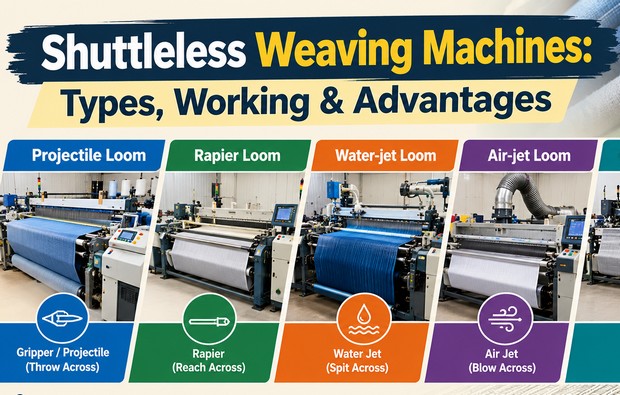
Why Shuttleless Looms Were Developed
A modern loom with a shuttle, although much faster in operation than the earliest automatic looms, is not easy to speed up further because of the variety of operations that the machine must perform. Time is needed to stop the shuttle and accelerate it in the other direction, and the weight of yarn on the quill that must be carried across the shed also limits the speed.
Shuttleless machines may be classified by the method used in inserting the filling yarns. Four basic types are used: machines with grippers or projectiles, machines with mechanically operated gripper arms or rapiers, machines employing water or air jets to carry the filling, and machines that form multiple sheds.
In hand weaving and automatic shuttle weaving, the filling yarn is continuous and runs back and forth across the fabric. In most shuttleless weaving, however, the filling yarn extends only from selvage to selvage because it is cut off before it passes across the shed. In all shuttleless weaving, the yarn for the filling is unwound from large, stationary packages of yarn that are set on either one side or both sides of the loom.
Because weaving speed depends on fabric width, there is every incentive to build wider machines for more efficient filling insertion. Widths do vary, so weaving speeds are generally reported as meters of filling yarn inserted per minute.
Types of Shuttleless Weaving Machines
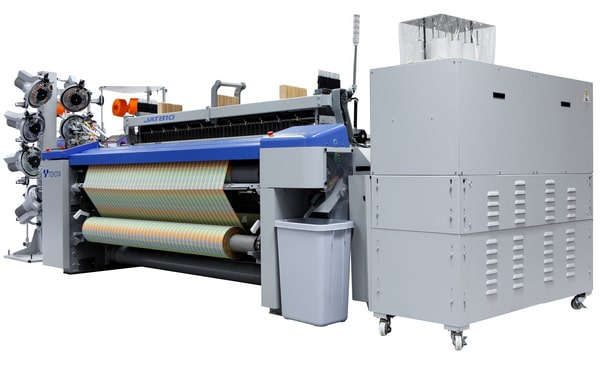
The main types of shuttleless weaving machines are the projectile loom, rapier loom, water-jet loom, air-jet loom, and multiphase loom. Each one inserts the filling yarn in a different way, but the goal is the same: faster weaving with less noise and better productivity.
Projectile / Gripper Loom
In the gripper or projectile type of weaving machine, a small, hooklike device grips the end of the filling yarn. As the gripper is projected across the warp shed, it tows the filling behind it. The gripper can move more quickly than a conventional shuttle because of its smaller size. It can travel farther more easily, making possible the weaving of wider fabrics, and it does not require the step of filling the shuttle because it pulls the yarn directly from a prepared yarn package.
Two types of gripper looms are used. In one, the gripper travels in only one direction and is returned to the starting point by a conveyor belt. To maintain the weaving speed, each machine must have several grippers, although only one is in use at any one time. In the other type of gripper machine, a single gripper inserts one filling yarn alternately from the right-hand and left-hand sides of the loom. The gripper serves the same function as a conventional shuttle, but instead of holding a quill, it carries the yarn behind it. Packages of yarn must therefore be placed on both sides of the machine.
The gripper machine not only weaves fabric more quickly than the shuttle loom, but it also runs with less noise, making it possible for manufacturers to comply more easily with government regulations that restrict noise levels. There is also a saving in power costs for wide-width fabrics. Narrow fabrics are not economically woven on this machine because too much time is spent in periods of acceleration of the gripper. Wide fabric widths are quite productive, as the power consumed is less than that for a conventional shuttle loom of the same size. Sheets are woven side by side on some of these machines to take advantage of these savings.
Rapier Loom
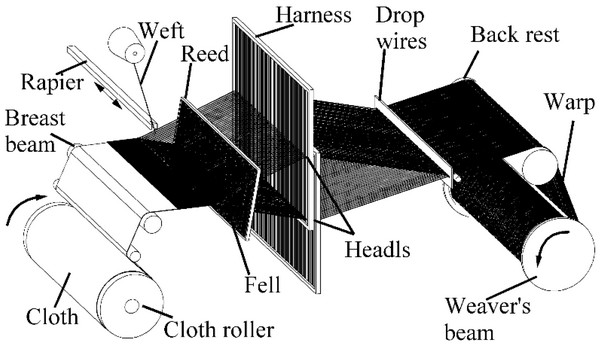
As in the gripper loom, a stationary package of yarn is used to supply the filling yarns to the rapier machine. One end of a rapier, a rod or steel tape, carries the filling. The other end of the rapier is connected to the control system. The rapier moves across the width of the fabric, carrying the filling through the shed to the opposite side. The rapier is then retracted, leaving the new filling in place.
In some versions of the machine, two rapiers are used, each half the width of the fabric in size. One rapier carries the yarn to the center of the shed, where the opposing rapier picks up the yarn and carries it the remainder of the way across the shed.
A disadvantage of both these techniques is the space required for the machine if a rigid rapier is used. The housing for the rapiers must take up as much space as the width of the machine. To overcome this problem, looms with flexible rapiers have been devised. The flexible rapier can be coiled as it is withdrawn and will therefore require less space. However, if the rapier is too stiff, it will not coil; if it is too flexible, it will buckle. The double rapier is used more frequently than the single rapier.
Water Jet Loom
Water-soluble warp sizings are used on most staple warp yarns. Therefore, the use of water-jet looms is restricted to filament yarns, yarns that are nonabsorbent, and those that do not lose strength when wet. These fabrics come off the loom wet and must be dried.
In this technique, a water jet is shot under force and carries a filling yarn with it. The force of the water as it is propelled across the shed carries the yarn to the opposite side. This machine is economical in its operation. A water jet of only 0.1 centimeter in diameter is sufficient to carry a yarn across a forty-eight-inch shed. The amount of water required for each filling yarn is less than 2.0 cubic centimeters.
Air Jet Loom
Air-jet looms operate in a manner similar to water-jet machines. Instead of projecting a stream of water across the shed, a jet of air is projected. The main nozzle provides the initial driving force. Electronically controlled relay nozzles provide additional booster jets to carry the yarn across the shed. They can weave multicolored yarns to make plaids and are available with different patterning mechanisms.
Multiphase Loom
All the weaving techniques discussed so far require that the shed be open all the way across the machine for the device carrying the filling yarns to pass through the shed. This imposes a limit on loom speed. The multiphase machine overcomes this limitation by forming many different sheds at different places across the machine and forming these only as the filling yarn is inserted.
In this way, a number of filling yarns can be inserted, one behind the other. As a section of the shed opens, the filling passes, and the shed closes, opening again in the new pattern as the next filling yarn arrives. If the weave pattern changes, small groups of yarns are changed into a new shedding position after each new yarn carrier has passed.
Speed is increased because of the number of yarns that can be inserted almost simultaneously, one right after the other, but the actual speed of movement of the filling yarns is lower than in other types of machines. For this reason, filling yarns that are weaker can be used.
Advantages of Shuttleless Weaving Machines
When patterned fabrics are woven on shuttleless weaving machines, colors can be changed more easily. Unlike shuttle looms, in which a different shuttle must be provided for each different color, the shuttleless machines can be supplied with a variety of colors directly from yarn packages.
Other advantages include lower power requirements, lower sound levels, smaller space requirements, and higher speeds of fabric production. Therefore, shuttleless weaving machines are replacing shuttle looms in many mills worldwide. The higher production rates of shuttleless machines require yarn quality to be high so that operation remains trouble-free. Shuttle looms can still be more economical for short and specialty runs of fabric.
Conclusion
Shuttleless weaving machines were developed to solve the speed and noise limits of the shuttle loom. Their main types, gripper, rapier, water-jet, air-jet, and multiphase, use different ways of carrying the filling yarn across the shed. Each type has its own strengths, from wider fabric production and lower noise to easier color changes and lower power needs. As mills continue to balance speed, noise, width, and yarn quality, shuttleless weaving will remain a strong option for many fabric styles.