Why Denim Finishing Matters
For denim manufacturers, a faded or worn fashion look can add value to denim fabrics and make them more attractive to younger customers. Operations used to create these looks include sanding, sandblasting, sand washing, snow washing, stonewashing with enzymes, prewashing, brushing, rinsing and bleaching. The nine finishing types below range from mechanical and surface treatments to crease effects and functional finishes. Some focus on appearance, while others also provide antimicrobial, antifungal or UV-protective properties.
Denim Finishing Techniques for Vintage Looks
1. Dry Denim Finishing and Distressing
Different mechanical and physical processes are used in the industry to give denim fabric an attractive look. One such finish is applied to pocket edges and bottom hems by rubbing the fabric against an abrasive surface or stone. A distinctive effect is achieved using a swift tag machine, with a plastic tag attached to the fabric to ensure high colour contrast.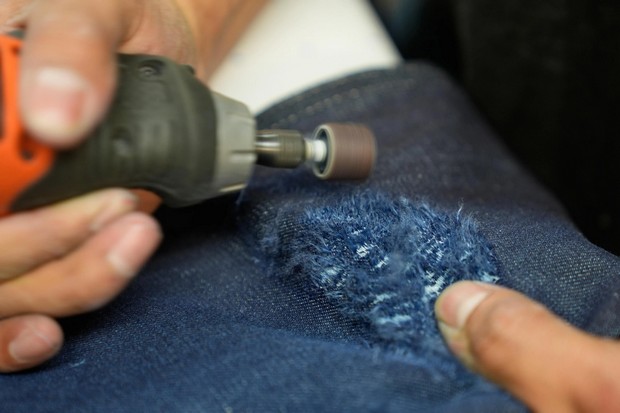
Controlled warp removal and the creation of holes in both the warp and weft also provide a vintage, worn look. The tie effect on denim is achieved by transferring an irregular dyeing effect to the garment through a process similar to stonewashing. It gives an attractive abraded effect to certain areas of the fabric. Permanent creases in specific areas, such as the pockets and hems, also create a worn and attractive look.
2. Leather and Wax Finish for Denim
Generally, leather and wax finishes form a thin layer on the denim surface and thus change the surface attributes of the treated fabric. Leather finishing is carried out using 660 g of an anionic acrylic solution, 20 g of a cross-linking agent, 283 g of water and 37 g of concentrated black pigment. The formulation is applied to the denim fabric at 55.5% pickup. The treated fabric is then dried and cured at 150°C for 5 min.
This finish is simple to apply and provides a fast surface treatment for specific effects. Short, dense fibres give a ‘peach skin’ effect. The leather finish can be applied to a small area or to the whole denim surface.
The wax finish, on the other hand, gives treated denim a smooth, oily and greasy touch. Applying a special binder and chemicals provides an elastic, soft and silicone-like film on the treated area. Wax finishing has been carried out using 200 g of cationic polysiloxane emulsion, 700 g of polyurethane binder, 20 g of a cross-linking agent and 80 g of black pigment, with an appropriate quantity of water. The denim fabric was treated with this formulation at 49.9% pickup, followed by drying and curing at an adequate temperature for a sufficient time.
3. Resin Finish for Denim
A special resin finish is used to impart an authentic three-dimensional permanent crease that is resistant to wear and washing. Resin can also be applied by spraying it directly onto the denim fabric surface. Creases can be formed using binder clips or aluminium pipes, either before or after spraying the resin.
Denim fabric has also been treated with a mixed formulation of 200 g/L glyoxal resin, 100 g/L acrylate polymer and 20 g/L catalyst for the synthetic resin. The wrinkles were formed on the denim fabric using a flexible aluminium table, followed by drying and curing.
4. Spider Finish on Denim
This treatment uses an anionic aqueous solution of a polysaccharide. It is applied to the denim fabric at 20.5%, followed by drying at 80°C. The fabric is then cracked and blown using compressed air. The broken areas are treated with a 5% permanganate solution and left for 10 min. The sample is then neutralized and treated with a nonionic softener, centrifuged and air-dried.
5. Strato Finish on Denim
In this process, denim fabric is treated with a mixed formulation of 100 g/L nonionic silicon emulsion and 5 g/L permanganate solution for 30 min at 30°C, with a material-to-liquor ratio of 1:15. The sample is then washed for 20 min at 60°C with a reducing agent and a softener, followed by centrifuging and air-drying.
6. Dirty Wash Effect on Denim
Pigment-based dyes such as Diresal Orange RDT and Diresal Brown RDT have been used to achieve a dirty effect on denim. Black pigment dyes have been used to impart a deep shade. A pigment dye solution can be applied to the fabric by controlled spraying. After treatment, the fabric has a careless and fashionably dirty look.
7. Ice Wash Effect on Denim
In this process, stones act as vehicles for depositing chemicals on garments to strip indigo colour from the denim surface. The chemicals deposited on the surface remove colour from the outer layer of the garment, creating an attractive, elegant, frosted appearance. Indigo- and sulphur-dyed denim fabrics are normally used for the ice-wash effect.
8. Wrinkle Finish on Denim
Resin is used by the denim industry to create a unique vintage look, such as a crinkle effect, which can add value to denim garments. In the 1980s, resin was used to provide non-press, iron-free cotton trousers. Now it is used on denim to create wrinkles and creases that impart a natural vintage look. The fabric takes on a natural colour that remains after multiple home washes.
A wrinkle, also known as a rhytide, is a fold, ridge or crease in cloth or garments that can give the fabric a vintage, aged look.
9. Antimicrobial and UV-Protective Finish for Denim
Two natural oils, sweet citrus and rose oils, have been used for the functional finishing of denim garments. The 2/1 right-hand twill fabrics were made from 100% cotton, cotton/polyester, 100% Tencel and Tencel/polyester blends. The oils were applied by the exhaust method, and the samples were tested for antimicrobial, antifungal and UV-protective properties.
Antimicrobial tests showed that cotton/polyester and Tencel/polyester denim fabrics inhibited bacterial growth much more than pure cotton or Tencel fabrics. The finished cotton and Tencel/polyester denim fabrics completely inhibited fungal growth. For UV protection, the reported percentages were excellent for cotton (97.5%) and Tencel/polyester (97.9%), followed by cotton/polyester (96.5%) and Tencel (94.7%) denim fabrics.
Conclusion
These nine denim finishing techniques range from mechanical abrasion and surface treatments to crease effects and functional finishes. They can give denim worn, frosted, dirty or textured looks, while natural-oil treatments also provide antimicrobial, antifungal and UV protection. This range leaves denim makers scope to continue developing garments with varied visual and functional effects.