Introduction
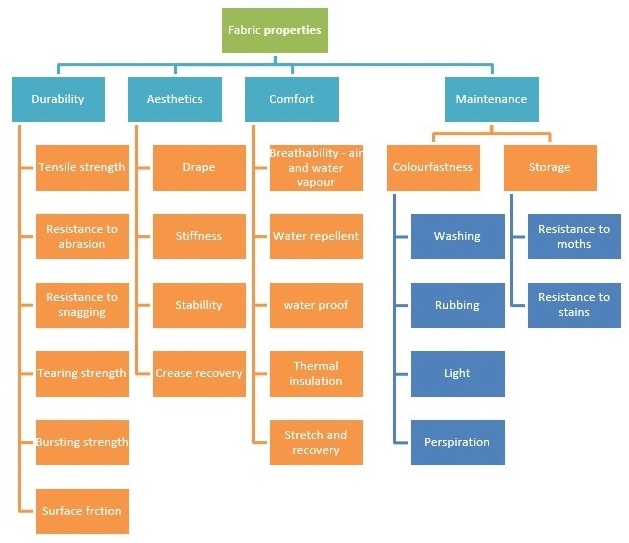
Fabric is not just a matter of color or pattern. In interior design, construction often decides whether a textile will suit a specific purpose, hold up to use and cleaning, and create the effect a client wants. It is also the first clue used when identifying a textile, before yarn type, color, or finish comes into play. That is why a basic understanding of fabric construction is so useful in practice.
Why Fabric Construction Matters
Interior design professionals need to understand textile construction for four main reasons. First, suitability for a specific end use is often established during the construction process. Second, the durability of a textile, its ability to withstand use and cleaning, is usually a direct result of fabric construction. Third, textile identification begins with construction, then moves to details such as yarn type, coloring, or finish. Fourth, special effects are possible through construction, so this knowledge is essential when speaking with clients or other professionals about a textile.
Main Types of Fabric Construction
Fabric is constructed in one of four ways: nonwoven and extruded methods, weaving, needle construction, and combination methods, also called compound cloth or textiles. Each method creates a different structure and appearance, and each has its own place in interiors.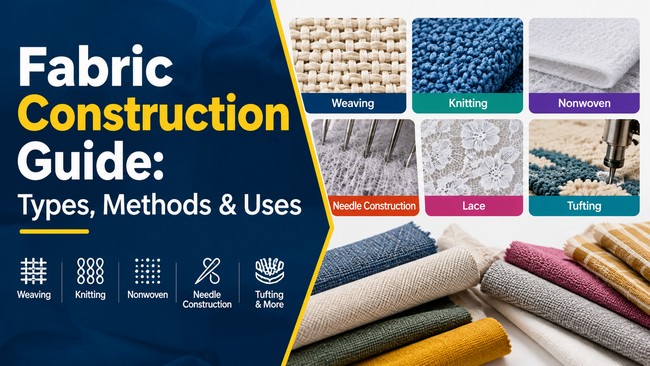
Nonwoven and Extruded Fabrics
Nonwoven fabrics are made in several ways, and in some cases the textile is built entirely of fibers with no yarns at all. One traditional example is tapa cloth, a natural nonwoven material from the South Sea Islands of the Pacific. It is made from mulberry tree bark, which is pounded until very thin and then painted. Tapa cloth is used for flooring, wallcoverings, and traditional apparel.
Fiber web construction includes webs or scrims made by a wet, dry, or melt method. In the wet method, fibers are suspended in water where they become tangled. A screen is brought up from underneath, the water is strained away, and a mesh of fibers remains. When the fibers dry, they stay tangled together as a fabric mass.
The punch bonding method uses barbed needles to punch up and down through a mass of fibers, pulling and interlocking them. Punch bonded polyester fiber batts are used as quilt interlining and are referred to as batting.
Spin bonding produces nonwoven textiles by heating a thermoplastic fiber mass until the fibers begin to melt or flow. It is then quickly cooled and welded together. Spin bonding can create nonwoven carpet squares in flat or ribbed textures.
These nonwoven textiles are useful as scrim applied to the underside of upholstered pieces, as nonwoven buckram or crinoline used to reinforce the tops of stiff pleated draperies, or for some types of mass produced pleated fabric shades. Heavier mesh is used for indoor outdoor carpet squares. Typically, synthetic manufactured fibers are used to make these products.
Foam is another nonwoven textile. It is made from synthetic or rubber synthetic blend sources that are engineered into a thick liquid. This viscous material is poured into large flat pans on conveyor belts and baked into forms of varying weight, height, and density. Foam is used as upholstery padding and cushions, carpet underlay or padding, and in other interior design uses.
Nonwoven textiles also include extruded fabrics, which are produced from a liquid into a flat sheet form. Thin extruded films slit or cut into tape yarns are one example. Vinyl upholstery is an extruded textile.
Common nonwoven textile examples include tapa cloth or bark cloth, buckram or crinoline, batting for interlining and upholstery padding, craft felt, cushion and carpet underlay or padding, extruded fabric, foam materials, interfacing or interlining, and upholstery scrim.
Woven Fabrics
Weaving is the process by which nearly all historic or period textiles were made, and it is still the method used to construct the vast majority of fabrics today. Weaving can be simple or complex.
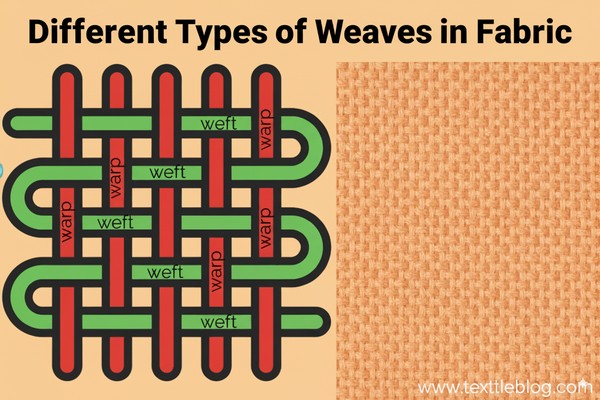
In biaxial weaving, one set of long or lengthwise warp yarns is interlaced at right angles with the crosswise weft or filling yarns in one of several over and under sequences. One single weft or filling yarn is called a pick or filling pick. When warp and weft are at perfect 90 degree angles, the fabric is on grain or grain straight. This means the 45 degree angle, or bias, of the goods is also true. When the interlacing is skewed or twisted, the quality of the fabric may be unacceptable, although the grain may be straightened during conversion or during coloring and finishing.
Selvages and Fabric Count
Selvages, the reinforced sides of woven textiles, prevent fabric fraying. They are created in four standard ways.
- Conventional selvage, a smooth, rounded return of the continuous weft yarn
- Tucked in selvage, the partial return interlacing of a single pick, useful where a yarn is inserted as a single row of color
- Compacted selvage, where the warp yarns are threaded closer together on the edges
- Leno selvage, where an hourglass twist in the insertion of the weft threads secures the sides
Thread count, or fabric count, is the number of warp and weft yarns in a square inch of fabric. It is most often referred to in bed linens. When the warp and weft are equal numbers, the fabric is said to be a balanced construction. The higher the count, the finer and denser the weave, which translates into more durable goods. The more dense or compact the weave, the more serviceable the fabric. Upholstery textiles are typically more compact than drapery fabric, for example.
How Looms Work
The loom is the machinery used for weaving textiles. Looms vary in width, complexity, and efficiency, from simple hand operated units, where hand labor creates unique and artistic pieces, to computerized machines that produce goods at very high speed. All have a place in interior design textiles.
Primitive looms produce a wide variety of unique goods, often filled with character and sometimes exquisitely executed. Simple hand operated looms include the box loom, made of a simple box with nails for attaching the warp and weft, and the backstrap loom, a narrow set of weft threads that requires only a top and bottom stick. One side can be secured to nearly any object, such as a tree or table, and the other to the weaver’s waist or another stationary object, then woven in a suspended state. These simple looms are used for craft purposes and for items such as belts and straps.
The quality of woven goods is often taken as an indicator of the level of a society’s cultural achievements. The more complex and finely woven the textiles, the more advanced the culture. Beautiful and complex textiles were and are possible where peace and prosperity reign, where refinement and aesthetics are valued, and where pride of craftsmanship, tradition, and weaving skill are developed.
Weaving has been an important part of many cultures, and not only for interior or apparel textiles. Traditional hand tied rugmaking is a weaving process, but the loom is an upright loom. The colored yarns that create the pattern are looped around or tied to the vertical warp threads, and a weft thread is inserted every few rows and tamped in place to secure the construction.
Two types of looms are used to create most fabrics today: hand looms and power looms. Hand looms include floor looms and table looms. The term jack loom refers to how the harnesses move, one type is counterbalanced and another is countermarche.
Weaving is accomplished by securing lengthwise or vertical simple, stronger than complex, yarns laid perfectly straight from large packages known as cheeses onto a creel frame. This unit lays the yarns straight in preparation for winding onto the warp or loom beam. The beam may hold up to 150 yards of warp yarn that, when woven, becomes the piece or bolt of finished textile. The warp or loom beam yarns may be slashed, sized or starched, then dried for greater strength and more consistent roundness. The sized yarns on the warp or loom beam are then mounted onto the loom.
Yarns are individually threaded through a heddle, a metal, nylon, or string strip with a small hole in the center. There may be as few as two heddles for simple weaves and up to sixteen heddles for complex patterns. The threading, or drawing in, of heddles follows a pattern draft. For a plain weave, even numbered yarns are threaded on heddle A and odd numbered yarns on heddle B, for example. One or more heddle units are lifted to form a shed, a sideways V, that allows the weft thread to be inserted.
The horizontal weft yarns are inserted with a shuttle, which is a boat shaped unit with yarns wrapped around a quill. The weaving is done by opening the warp shed with a foot pedal and inserting by hand a shuttle encasing a bobbin that unwinds and deposits the weft yarn. The shed is closed, and the beater bar or lay, a frame that holds a reed or comb through which each yarn is held separately to keep it in perfect alignment, is pulled forward to tamp down, or batten, the weft yarn, holding it snugly in place. This step assures uniform spacing and keeps the weft on grain. The shed is then reopened in a different configuration. The shed configurations are determined by the lacing of the heddles, which are raised and lowered by the pedal operation.
Plain, twill, satin, and combination weaves and their variations can be executed on the hand loom. Plain weave requires only two heddles; the other weaves require more. Finished textiles are wound around a cloth beam or breast beam. The finished fabric may be one continuous length of up to about 150 yards, or it may accommodate several lengths of fabric with one set of warp yarns, including possible changes in the interlacing configuration by rethreading the heddles.
Hand looms were used to create all textiles until the seventeenth century, when the first automated or power looms were invented. Today, hand looms are used for textiles that are created one at a time as unique and personalized or artistically individual creations. The ability hand looms give to change designs or yarn colors and to be inventive produces textiles that are sought after for their distinctiveness or custom qualities. Fabrics hand loomed include rag rugs, rug or wall tapestries, blankets, table linens, and decorative textiles. Some people enjoy the craft of hand loomed weaving and its artistic and therapeutic effect so much that weaving becomes a hobby of first choice, and some even have looms in a studio portion of their homes. Hand loomed textiles created by artisans or craftspersons are often sought by interior designers and artistically sensitive people who want a one of a kind piece or textile with unique or coordinating coloration or special effects.
Power looms were first deployed in the seventeenth century in Europe, revolutionizing the textile industry. Today, the vast majority of textiles, excluding authentic Oriental, folk, and rag rugs, are constructed on power looms in mills around the world. For both the power loom and the hand loom, the steps of weaving are essentially the same: shedding, picking, battening, and taking up and letting off.
- Shedding is the opening of the shed. In power looms, this process is automated; in hand looms, it is hand or foot operated.
- Picking is the insertion of a pick or single weft yarn. In hand looms, the shuttle is hand thrown. In conventional power looms, the shuttle is sent flying through the shed by a hammerlike device. These are called flying shuttle looms. Other power looms do not use shuttles. One type of shuttleless loom is a rapier loom, and rapier is French for sword. The rapier is a projectile device that carries the pick halfway across the shed, where it is grasped by another rapier that carries it the rest of the way. Then the process reverses. In the air jet method, a burst of air shoots the picks through the shed. In the projectile method, a pick attached to a projectile is shot through the shed; both ends are cut and tucked into the next shed to form a tucked in selvage.
- Battening is the tamping down of the heddle or lay to secure the weft yarn in place and keep the fabric construction consistent.
- Taking up and letting off comprise a two part, simultaneous process. Taking up is the cutting of the warp yarns to remove a finished length of fabric from the loom, and letting off is the beginning of a new piece of fabric where the warp yarns are attached to the cloth beam.
The power loom is far faster and more efficient than the hand loom. Today, they are primarily computer controlled. Fabrics are cut from the last of the warp threads with a laser instead of with scissors, another technique that speeds production. Attachments to the power loom create variations such as embroidered detail, lappet or swivel embellishment, or dobby patterns.
Knitted and Needle Constructed Fabrics
Needle constructed textiles form a broad category of textiles that achieve many different effects, including knits and lacy or open constructed textiles. Handmade needle constructed fabrics have played a key role in interior design as accessories or small upholstery fabrics. Examples include knitted or crocheted afghans, throws, pillows, and accessory items. These can add a personal touch to a home. Handmade laces such as doilies, dresser scarves, or runners protected, and perhaps still do, fine furniture from being scratched by objects of art. Lace has many uses, including curtains, bed canopies and hangings, bed skirts, pillow tops, and even altar covers in churches.
Mass produced needle constructed fabrics are a significant part of textile manufacturing today. They include knitting, machine knitting, malimo and arnache, lace, tufting, and passementerie.
Knitting
Knitting is the process of interlacing a single yarn into fabric. Hand knitted textiles are constructed with a pair of knitting needles. Such needles come in many sizes, and the size is chosen according to the size of the yarn. Machine knitting uses hundreds of needles on complex machines. Knitting has limited use in interiors, although it is widely used in the apparel market.
Hand knitted textiles in interior design are limited to afghans or throws, hot pads, and craft accessory items. They are a more contemporary application compared to the history of handmade lace. The design quality of knitted textiles for the home varies. Some knitted afghans are lofty, soft, and beautiful, and if they are relatively neutral in color, they can have long lasting appeal. Hand crocheted baby blankets can become treasured items. On the other hand, some craft items are incidental and of questionable design quality, such as brightly colored knitted toilet paper roll holders. Color and yarn selection have a great deal to do with the beauty and long term appropriateness of the finished items.
Hand knitted examples include afghans or knitted blankets, hot pads, and craft accessory items.
Machine Knitting
Circular knitting machines yield jersey knit or single knit textiles, double knits, and stretch knits. Single or jersey knit textiles, particularly those made of nylon, including tricot, are used for some bedding and limp draped applications. The heavier double knit may be used for upholstery, but stretch knit is more likely used for modern sculptural upholstered pieces that require fabric that hugs the form.
Knitted textile examples include jersey or single knit, tricot, double knit, milanese, suede cloth, and stretch knit upholstery fabric.
Rachel or Raschel Knits
The Rachel or Raschel knit is a needle construction method used to produce casement drapery fabrics. It is also called a warp knit. In this method, the horizontal yarns, often unusual novelty yarns, are held together by knitting very fine thread, sometimes fine, clear monofilament, spaced vertically, or in the lengthwise warp direction. The fabric is semisheer with novelty effects. Rachel knits can construct fabrics up to 118 inches wide for seamless draperies.
Rachel or Raschel knit examples include Rachel or Raschel knit and casement.
Malimo and Arnache
These needle construction methods produce drapery casement fabrics quickly and economically. Malimo or malivatt fabrics, named after the respective machines on which they are produced and invented in Germany, are constructed by laying down banks of weft yarns and then interlocking them with a lace like interlocking stitch in a clear, fine monofilament. These banks or swatches of yarns may not lie perfectly straight but may overlap each other in a random horizontal manner. Arnache textiles are similar, but just one yarn at a time is inserted, creating a more precisely even or horizontal appearance. In both the malimo and arnache constructions, a nonwoven substrate layer can be laminated or stitched to the surface so the fabric becomes translucent rather than semisheer, which is useful where privacy is important.
Malimo and arnache examples include Malimo, malivatt, arnache, and casement.
Lace Fabrics
Handmade Lace
Handmade lace is a centuries old art form that enthusiasts believe is the way real lace is created. There are five handmade lace techniques: bobbin or pillow lace, needlepoint or point lace, tatting, tape lace, and crocheted lace.
Bobbin or Pillow Lace
Bobbin or pillow lace takes its name from the bobbins used to pull the threads tight during the process, and pins hold the work in progress to a pillow form. A design is first created by pricking holes in paper, and the pins go into the holes to act as guides for the threads. Complex designs may require hundreds of bobbins. Bobbin lace is traditionally used for window treatments, tablecloths, and accessory items such as pillows.
Bobbin lace examples include Antwerp, Binche, Brabant, Bruges, Chantilly, Cluny, duchess, genoise, milanese, and rosaline.
Needlepoint or Point Lace
This lacemaking technique spread throughout Europe during the Renaissance. It is a type of embroidery using a needle in a buttonhole stitch. Needlepoint or point lace is also used for window treatments, table covers, and accessory items.
Needlepoint lace examples include Alençon, argentan, gros point, rose point, point de France, and reseau.
Tatted Lace
Tatted lace is the most recent handmade lace, being invented in the mid nineteenth century. Tatting is made by knotting thread in a lark’s head knot or stitch with a very small shuttle. The stitches are tied together in circles or along a foundation thread, with decorative loops protruding from the circles. Tatted lace is used for edges and trimmings.
Tape Lace
This technique involves weaving thin strips of plain weave to form leaves or flowers by folding corners to make curves and points, then filling in the spaces with a looped stitch. The leaves are held together with slack twisted thread. Tape lace is usually made of linen or cotton and is the form most often used in Battenberg lace, imported from China or Europe. In interiors, Battenberg consists of cotton tape lace sewn onto cotton muslin or percale in white, off white, or pale colors. It is used for bed linens, window treatments, and accessory items.
Crocheted Lace
Crocheting is the interlooping of a single yarn to form a pattern. To form lace, the yarn is typically the size of a sturdy, thick thread. A single instrument, the crochet hook, about the size of a pencil, is thin, with a small hook used to catch and loop yarns together. Crocheted lace can form the edging of textiles, such as pillowcase or blanket edging, or it may be used for an allover lace piece suitable for coverlets or altar covers.
Machine-Made Lace or Leaver Lace
Machines that produce lace were first invented by Englishmen John Heathcoat and John Leavers in the early nineteenth century. Today, lacemaking machines work on many of the same principles as the original mechanisms. Machine made lace is even and nearly flawless compared to the potential inconsistencies in handmade lace. However, lace purists sometimes refer to machine lace as imitation lace because it does not possess the character and labor of love of handmade lace. Machine made lace is typically seen as floral or geometric patterns on a background of hexagonal or geometric mesh or net. The weight of this lace varies from fine and thin to heavy, with heavier yarns imitating cotton lace. Machine made lace mainly is imported from Europe, with a few sources in the United States.
For window treatments, lace yardage is available in America in a wide variety of styles in widths of 24, 36, 48, 54, 72, 104, and 118 inches. Curtain lace often has finished edges such as scallops. Valance and café curtain lace yardage may also have a finished heading, some with large loops through which a curtain rod may be inserted as self curtain rings. Other laces have slit openings so ribbon can be threaded vertically to create a poufed shade or decorative effect. Some lace that is 24 to 30 inches wide is scalloped on both selvages to become finished French door panels.
Most machine lace is polyester and can be safely washed or dry cleaned. Because of this, machine made lace can be made into nearly any type of window treatment, decorative bedding, table linens, accessory items, and trimmings. Polyester laces are dimensionally stable and, when layered with a lining fabric, can be fabricated into items that typically require light to medium weight opaque textiles. The same names are used for machine made and handmade laces, but the machine made laces are imitations of a particular style. More often, the manufacturer or jobber who has purchased piece yardage from a lace manufacturer will give each lace a pattern name to identify it within the line of goods.
Lace construction without pattern is called net and comes in different sizes and weights. Mesh is large, net is a medium scale, and tulle is very fine net. Net is used for underlining to give fullness and stiffness, such as for bed skirts. Net may also be used for window and bed drapery for decorative purposes. Mosquito netting is gauze, a plain, loosely woven semisheer textile with a netlike appearance. It is draped over beds to keep the sleeping occupant safe from mosquitoes. Such netting also may be used decoratively.
Machine made lace examples include lace named by manufacturer or jobber, Nottingham lace, imitations of handmade laces, mesh, net, and tulle.
Tufted Fabrics
Tufting is the insertion of yarns into a nonwoven or plain weave base fabric in order to create a pile. The yarns can be cut or uncut. In carpeting, there must be an application of latex or another compound to hold the back of the tufted yarns in place. Most tufted textiles are broadloom carpeting, although some velour and chenille textiles are tufted. Tufted bedspreads have Colonial or Victorian patterns. Bath mats or rugs are also tufted, cotton without a backing and nylon or polyester with a rubber backing that eventually peels or flakes off with age and exposure to heat from washing and drying. Cold water washing and line drying extend the life of the rubber backing.
Tufting examples include broadloom tufted carpeting, upholstery velour, tufted bedspreads, bath mats, and throw rugs.
Passementerie and Decorative Trimmings
Passementerie is manufactured trimmings, including fringe, gimp, tassels, cord, and braid. The processes for creating passementerie are hand methods related to lacemaking, often automated. Trimmings are made by twisting, knotting, and weaving in various configurations with fine silk, rayon, polyester, or cotton threads or yarns. Some trimmings are made with coarser cord or of less refined or natural linen or cotton fibers.
Fringe and tassels are used for trimming draperies, upholstery, pillows, and bedding. Large tassels held with cord are used as tie backs. Smaller key tassels, named because they were historically attached to a house key as a sort of key chain, are often used as accents hung on a drawer handle or arranged as part of a grouping of small accessory items. Gimp and deep boullé fringe are used to cover upholstery tacks or in place of an upholstery skirt on chairs, sofas, or ottomans respectively. Boullé fringe was originally fashionable in the Victorian era.
Passementerie examples include braid or galloon, flat braid or galloon, raised openwork braid or galloon, border, cord and rope cord, barrier rope, cord tie backs, rail rope or stair cord, fringe, base fringe, boullé or bullion fringe, cut moss or moss edge fringe, fine cut fringe, glass bead fringe, loop fringe, netted tassel fringe, rat tail fringe, tassel fringe, multitasseled fringe, wood mold fringe, gimp or guimpe, flat gimp, raised surface gimp, corded gimp, grosgrain, ribbon, rosettes, bows, tufts, frogs, tie backs, tassels, chair tassels, chair ties, chandelier tassels, key tassels, and tassel tie backs.
Conclusion
Fabric construction gives a textile its behavior, its serviceability, and often its visual character. Nonwoven and extruded fabrics, woven goods, needle constructed textiles, tufted fabrics, and passementerie each serve different roles in interiors. Once the construction is understood, yarn type, color, and finish become easier to judge in context. That makes textile selection more precise, more confident, and better prepared for future design needs.