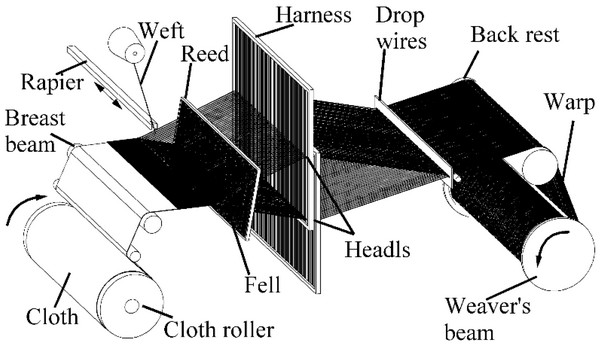
Garment manufacturers choose a fabric weaves and weight by working backwards from the finished product. They start with how the garment must drape, stretch and wear, then pick the construction that delivers it. Only after that do they set a weight in GSM and confirm the fabric can be repeated, roll after roll, at the order quantity. In bulk production, the right fabric is the one that performs in the lab, cuts cleanly on the table and stays consistent across every lot.
That last point is where many first production runs go wrong. Picture a brand approving a 180 GSM cotton jersey for its first 5,000 T-shirts. The swatch feels right, the fit sample looks right and the lab report passes. Then the bulk rolls arrive from a new dye lot. After washing, the garments shrink 4% in length instead of the 2% the pattern allowed for, and the whole size run lands outside tolerance. Nothing was wrong with the swatch. The problem was that nobody had defined what “the same fabric” meant at bulk volume.
This guide explains how production teams make each decision, from fabric weaves to weight, testing and sourcing, and what to check before a purchase order is signed.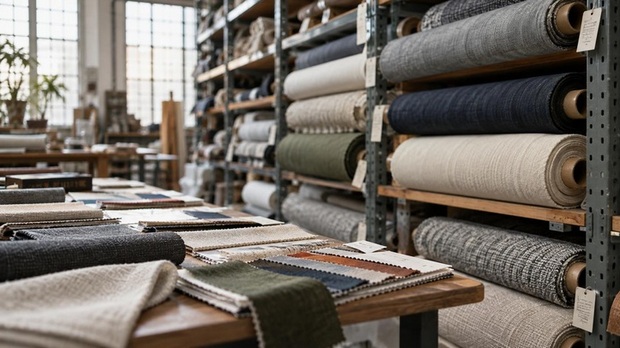
Why do weave and weight matter more in bulk production?
In bulk production, a small fabric decision is multiplied by thousands of garments. Take a jersey that arrives 10 GSM heavier than planned. A standard T-shirt consumes roughly 1.1 square metres of fabric, including cutting waste, so each shirt carries about 11 grams more. For a knit bought by the kilogram at, say, US$6/kg, that is around US$0.07 per shirt, or roughly US$1,300 across a 20,000-piece order, before the extra freight. Shrinkage scales the same way. An extra 2% takes 1.5 cm off a 75 cm body length, which is more than the ±1 cm tolerance many buyers set, and it hits every size in the run at once.
Fabric weaves and weight also decide how a fabric behaves in the factory. They affect how many plies can be spread and cut at once, how the needle and thread must be set and how seams hold under stress. A loose satin that slips on the cutting table, or a heavy twill that skips stitches on a lightweight machine, slows the line and raises rejection rates.
For that reason, production teams treat fabric selection as an engineering decision, not only a design one. Merchandisers, pattern makers and quality teams usually sign off together before a fabric is approved for bulk.
How do manufacturers match a weave to the garment?
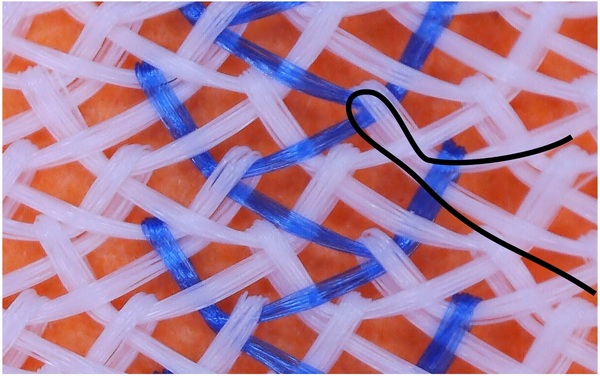
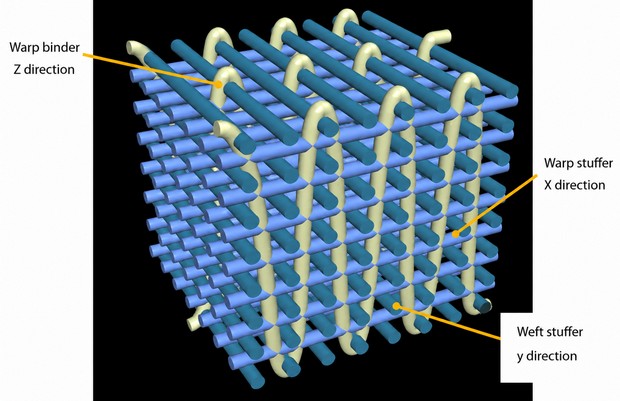
Manufacturers match a fabric weaves to the garment by asking what the fabric must do in use: hold a crease, drape, resist abrasion, stretch or show a pattern. Each weave structure answers one of those needs better than the others. The table below summarises the main constructions used in apparel production.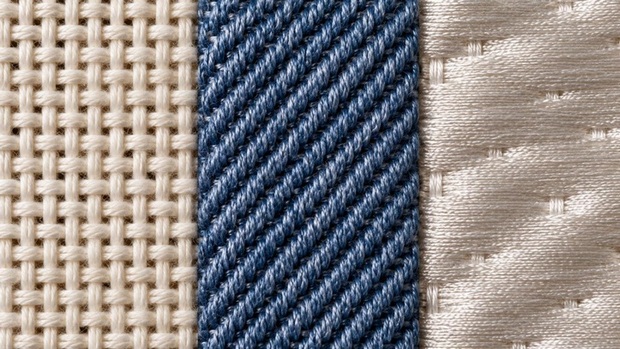
| Construction | How it is built | Strengths in production | Watch-outs in bulk | Typical garments |
|---|---|---|---|---|
| Plain weave (poplin, voile, calico, canvas) | Each weft passes over one warp and under the next | Stable, crisp, prints sharply, cuts cleanly | Wrinkles easily in wear, though it also takes a sharp pressed crease; low drape in heavier weights | Shirts, blouses, linings, workwear |
| Twill (denim, chino, drill, gabardine, herringbone) | Yarns float over two or more yarns in the other direction, stepped row by row to form a diagonal | Dense, abrasion resistant, drapes better than plain weave at the same weight | Twill direction and shading must be kept consistent when cutting; unskewed denim can twist after washing | Jeans, trousers, jackets, uniforms |
| Satin and sateen | Long floats on the face, few interlacings | Lustre, smooth hand, fluid drape | Snagging, seam slippage, slips on the cutting table | Eveningwear, linings, bridal |
| Dobby | Small repeating geometric figures woven in | Texture without printing | Small repeats may still need matching at seams | Shirting, dresses |
| Jacquard and damask | Each warp controlled individually for large figures | Complex woven patterns, premium look | Higher cost, longer lead times, pattern matching raises consumption | Formalwear, outerwear, accessories |
| Ripstop | Reinforcing yarns woven in a grid | Tear resistance at low weight | Seam slippage and visible needle holes; nylon and polyester versions are heat sensitive when pressed | Outdoor, technical and military wear |
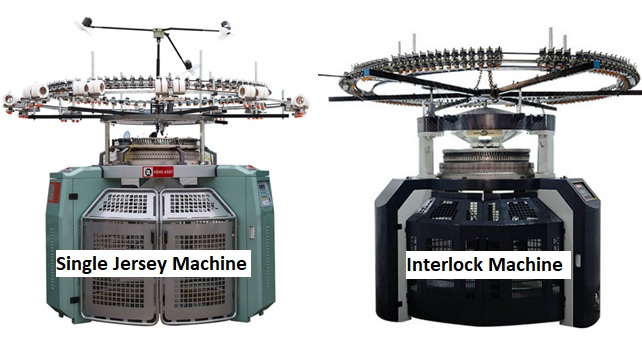
| Single jersey, interlock, rib (knits) | Interlooped yarns rather than interlaced | Stretch and recovery, comfort | Edge curling, spirality and width shrinkage | T-shirts, base layers, cuffs |
| French terry and fleece (knits) | Knitted with loops or brushed pile on the back | Warmth, softness, structure | GSM and shrinkage vary more between lots | Hoodies, sweatshirts, joggers |
Woven and knitted fabrics also behave differently on the sewing line. Wovens need seam allowances that resist fraying and slippage. Knits need stretch stitches, such as overlock and coverstitch, and careful handling to avoid distortion. Production teams usually decide early whether a style is woven or knitted, because the factory’s machinery and operator skills often favour one or the other.
Pattern weaves need extra planning. Plaids, herringbones and large jacquards often need matching across seams, which can raise fabric consumption per garment compared with a solid of the same weave.
How do manufacturers choose the right fabric weight?
Manufacturers choose fabric weight by balancing four things: season, opacity, durability and cost. Weight is usually stated in grams per square metre (GSM). Denim and some US suppliers use ounces per square yard, where 1 oz/yd² equals about 33.9 GSM.
The ranges below are common starting points for apparel. Brands then fine-tune within each range to suit their market, price point and fit.
| Garment | Typical construction | Typical weight (GSM) | Approx. oz/yd² |
|---|---|---|---|
| Summer blouses, scarves | Voile, lawn, chiffon | 60–100 | 1.8–3.0 |
| Dress shirts | Poplin | 100–130 | 3.0–3.8 |
| Casual shirts | Oxford, chambray, light twill | 130–170 | 3.8–5.0 |
| T-shirts (standard) | Single jersey | 140–200 | 4.1–5.9 |
| T-shirts (heavyweight, streetwear) | Single jersey | 220–260 | 6.5–7.7 |
| Suits and blazers | Twill, gabardine, worsted blends | 220–300 | 6.5–8.8 |
| Chinos, uniforms | Twill, drill | 200–280 | 5.9–8.3 |
| Sweatshirts, joggers | French terry | 230–350 | 6.8–10.3 |
| Heavyweight hoodies | French terry, fleece | 350–500 | 10.3–14.7 |
| Jeans | Denim (twill) | 340–475 | 10–14 |
Weight interacts closely with weave. A 200 GSM twill drapes better and shows wrinkles less than a 200 GSM plain weave, while a 200 GSM jersey feels far softer than either. That is why buyers compare fabrics on weave and weight together, never on weight alone.
Weight also sets perception. Many streetwear brands now market hoodies by GSM, so a buyer may compare several French terry qualities side by side before choosing. For instance, hoodie fabrics listed by GSM and fibre blend run from midweight terry for sweatshirts up to around 500 GSM for heavyweight styles.
In bulk orders, the agreed weight should always carry a tolerance. A range of plus or minus 5% of the stated GSM is a common commercial standard, measured by cutting and weighing a circular sample. Writing the tolerance into the purchase order prevents disputes when bulk arrives slightly lighter than the approved sample.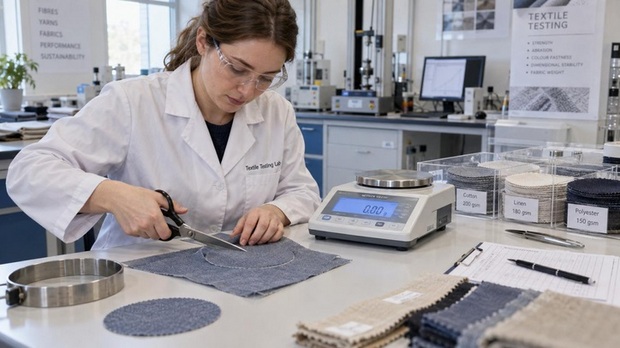
How do fibre content and finishing change the choice?
Fibre content can make two fabrics with the same fabric weaves and weight behave very differently. A 100% cotton twill breathes well but shrinks and creases more. A cotton-polyester twill of the same GSM holds its shape, dries faster and usually costs less, but feels warmer and pills sooner.
Adding spandex changes the picture again. Even 2–5% elastane gives a woven or knitted fabric stretch and recovery, which allows closer fits and fewer darts. It also makes the fabric more sensitive to heat setting, so finishing must be controlled carefully from lot to lot.
Finishing is the final variable. Mercerising, brushing, peaching, enzyme washing and resin treatments all change hand feel, lustre and sometimes weight. A brushed fleece, for example, can gain bulk while losing a little strength. Manufacturers therefore approve the finished fabric, not the greige cloth, and specify the finish by name on the order. The yarn quality parameters behind the fabric, such as count and twist, also affect how evenly a finish takes.
How do manufacturers test fabric before bulk approval?
Manufacturers test fabric in stages, so that problems surface on a few metres rather than a few thousand. The checks fall into two phases. During development, the team approves the fabric itself: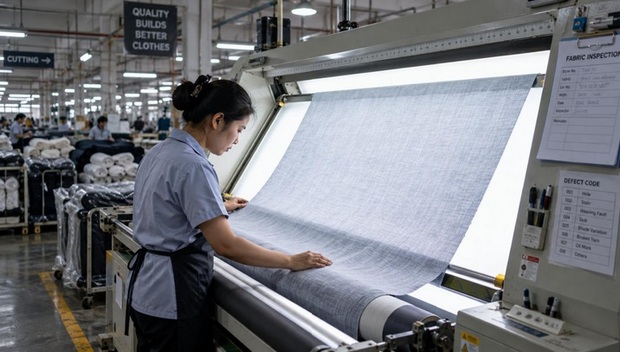
- Swatch and hand-feel review. The design team checks drape, hand and appearance against the product brief.
- Lab dips and shade approval. For dyed fabric, the mill submits lab dips early, often alongside the first samples, and the buyer approves a shade under agreed light sources, such as D65 daylight and TL84 store lighting.
- Sample yardage and fit sample. A garment is sewn from sample fabric to confirm fit, seam behaviour and appearance after pressing.
- Lab testing. Common tests cover GSM, dimensional stability (shrinkage) after washing, colourfastness to washing and rubbing, pilling, and tear or seam slippage strength for wovens. Many buyers set a shrinkage limit of 3–5% for knits and lower for wovens.
When bulk fabric arrives, it has to prove it is the same fabric, roll by roll:
- Bulk lab retest. GSM, shrinkage and colourfastness are retested on the bulk lot, because a new dye or finishing batch can change results that passed at sampling.
- Bulk fabric inspection. Incoming rolls are inspected before cutting, usually under the 4-point system defined in ASTM D5430. Each defect scores 1 to 4 points by length, and the total is calculated per 100 square yards.
- Shade banding and width check. Rolls are grouped by shade so that panels of one garment never come from visibly different lots, and usable width is measured against the order.
Each buyer sets its own pass limits, but the key rule is the same everywhere: the bulk fabric must match the approved sample within agreed tolerances. Keeping a signed reference swatch on file gives both sides a clear benchmark if a dispute arises.
Two shop-floor habits prevent most of the surprises. First, experienced factories wash-test the bulk fabric themselves and build the measured shrinkage into the pattern, rather than relying on the mill’s figure. Second, knits are unrolled and left to relax, often for 12 to 24 hours, before spreading, so the fabric does not shrink back after the panels have been cut.
Which sourcing factors decide the final fabric?
The final choice often comes down to sourcing, not only performance. A fabric that tests well but cannot be supplied consistently, on time and at the right width is a risk for any production plan. Production teams usually weigh these factors:
- Minimum order quantity (MOQ). Mills with high MOQs suit large programmes, while stock suppliers selling by the yard or by the roll suit sampling, small brands and repeat top-ups. Catalogues that list the weave, fibre content and GSM of every quality, such as Global Fabric Wholesale’s range of woven and knitted fabrics, also make it easier to shortlist options before ordering samples.
- Lot-to-lot consistency. Repeat orders must match earlier deliveries in shade, GSM and hand. Buyers ask whether a fabric is a stock quality or made to order each time.
- Usable width. Cuttable width, not full width, decides how efficiently patterns fit into a marker. A few centimetres can change fabric consumption per garment noticeably.
- Lead time. Stock fabrics ship quickly, while custom weaves, jacquards and special dyes can add several weeks.
- Cost per garment. Teams compare the cost of fabric consumed per finished piece, including waste and pattern matching, rather than the price per metre alone.
- Compliance and certification. Many brands require certificates such as OEKO-TEX Standard 100 for harmful substances, GOTS for organic content or GRS for recycled content where those claims are made, plus factory and environmental audits.
Buyers working with newer suppliers often follow a step-by-step manufacturer selection process, and the same discipline applies to fabric. Ordering sample yardage first, testing it and then placing a trial run is still the most reliable way to protect a large order.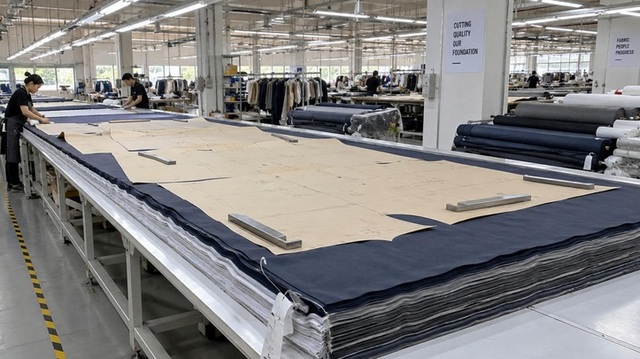
Choosing fabric for the production line
The best bulk fabric is chosen in a clear order: end use first, then weave, then weight, then fibre and finish. Testing confirms the choice, and sourcing decides whether it can be repeated. Garment manufacturers that follow this sequence spend less time fixing problems on the cutting table and more time shipping on schedule. For any new style, the safest habit remains the simplest one: sample, test and agree tolerances before the bulk order is placed.