Introduction
From industrial belts to composite preforms, woven structures are often expected to do more than simply cover a surface. Multi-ply fabrics and 3D fabrics meet that need by adding thickness, layering, and structural stability. The basic weaving cycle still remains the same, but the yarn arrangement changes the final shape of the cloth. That is why the move from 2D fabrics to multi-layer and true 3D structures deserves a clear, ordered explanation.
Design of Multi-Ply Fabrics
The multi-ply fabric consists of at least three cloths woven one above the other and stitched together on the principle of double cloth design. The number of fabrics in a multi-ply fabric usually varies from three to eight. A narrow eight-ply fabric is used as an industrial belt. In this kind of structure, the stitching arrangement decides how the layers are held together and how the cloth behaves as a single unit.
Weaving Cycle
Weaving is a textile production method in which two distinct sets of yarns or threads are interlaced at right angles to form a fabric or cloth. The weaving process is usually defined by a repeating four-step cycle:
- Shed formation: An opening is created in the warp, or machine-direction, yarns so that the weft, or filling, yarn can pass through. The successive shed changes create the weave pattern.
- Weft, or filling, insertion: The weft yarn is inserted into the shed.
- Beat-up: The weft yarn is beaten into the fell of the cloth.
- Take-up and let-off: The resultant fabric is taken up from the fell, and a corresponding amount of warp yarn is let off to fill the void.
Successful repetition of this cycle produces a woven fabric.
Traditional woven fabrics are assumed to have clearly defined length and width, but very little thickness. These traditional fabrics, along with fabrics for composite materials, are treated as 2D fabrics or two-dimensional fabrics. 3D fabrics or three-dimensional fabrics follow the same basic principle as 2D fabrics, but they possess a noticeable third dimension of significant depth or thickness created during the 3D weaving process.
Third-Dimensional Fabrics
The definition of 3D fabric is that these types of fabrics have a third dimension in the thickness layer. The basic principle for designing a 3D fabric is similar to that of a 2D fabric, but an additional third dimension must be created by means of extra warp yarns and manipulated into multiple layers. In 3D fabric structures, the vertical dimension (Z) is considerable relative to the longitudinal (X) and horizontal (Y) dimensions. Fibres or yarns are intertwined, interlaced, or intermeshed in the X, Y, and Z directions. Depending upon these three types of yarn, their relationship and their interlacement produce different types of 2D and 3D fabrics.
Types of 2D and 3D Fabrics
- Interlaced 2D fabric: The conventional 2D weaving process produces an interlaced 2D fabric on a 2D weaving device. This creates interlacement between two orthogonal sets of threads, warp and weft.
- Interlaced 3D fabric: This is also referred to as a multilayer fabric and consists of two sets of yarns on a 2D weaving device. It is basically an interlacement of two orthogonal sets of yarns, warp and weft, with an additional set of yarns functioning as binder warps or interlacer yarns in the through-the-thickness or Z direction.
- 2.5D fabric: This is basically pile fabric and consists of three sets of yarns, ground warp, pile warp, and pile weft, to produce pile fabrics by the conventional 2D weaving process.
- Non-interlaced 3D fabric: This consists of three sets of yarns to produce a non-interlaced fabric with yarns in the warp, weft, and through-the-thickness directions. This is produced on a 2D weaving device.
- Fully interlaced 3D fabric: This consists of three sets of orthogonal yarns interlaced on a specifically designed 3D weaving machine. The weaving shed operates both row-wise and column-wise.
- Non-woven fabric: A non-woven, non-interlaced 3D fabric forming process is designed to connect three orthogonal sets of yarns together with no interlacing, interloping, or intertwining. The fabric is held together by a special binding process.
This manipulation of the warp, with multiple layers woven using extra filling insertions, creates the fabric’s depth by weaving through the thickness. It is commonly referred to as through-thickness weaving. The through-thickness weaving and connecting of warp and fill layers generate the 3D woven fabric’s highly desirable and inherent through-thickness physical properties. 3D fabrics can be of several types.
Multi-Layer 3-Ply Fabric: Treble Cloth
Three-ply fabric is the smallest ply fabric, and it is also known as treble cloth. In a three-ply fabric, there are front, centre, and back fabrics. This means there are three sets of warp yarns, face, centre, and back, as well as three sets of weft yarns, face, centre, and back. These fabrics can be joined together by stitching the face cloth with the centre cloth and the centre cloth with the back cloth. So the stitching is usually done like double cloth stitching by any of the following means: (1) from centre to face and back to centre, (2) from face to centre and centre to back, (3) from face to centre and back to centre, (4) from centre to face and centre to back, or (5) a combination of stitching.
So for stitching, the double cloth principle should be adopted. A treble cloth will have the following types of interlacements.
- Face warp with face weft, forming the face design
- Centre warp with centre weft, forming the centre design
- Back warp with back weft, forming the back design
- Face warp with centre weft, floating
- Face warp with back weft, floating
- Centre warp with centre weft, floating
- Face warp with centre weft, stitching
- Face weft with centre warp, stitching
- Centre warp with back weft, stitching
- Centre weft with back warp, stitching
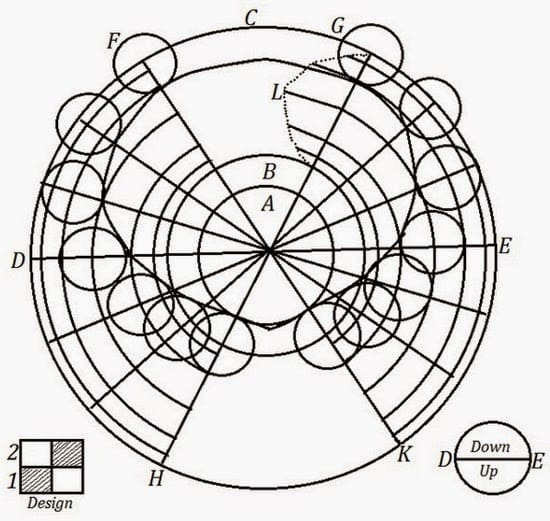
The cross section and the design of the two tubular arrangements show different stitching paths. In one case, the stitching is done by face to centre and back to centre, and in the other case it is centre to face and centre to back. In the first arrangement, the stitching is done by lowering the face end under the centre pick. As the floating of the face end over the centre pick is marked by a sign, that sign is withdrawn from this point. Further, the stitching of the centre fabric and back fabric is done by interlacing the back end over the centre pick.
The design of the treble cloth with stitching by centre to face and centre to back follows the same logic. The stitching of the face fabric and centre fabric is done by interlacing the centre end over the face pick, and this is specially marked by a sign. The stitching of the centre fabric and back fabric is done by lowering the centre end under the back pick. As the floating of the centre end over the back pick is noted by a sign, that sign is withdrawn from this point.
In a similar manner, the treble cloth can also be stitched from centre to face and back to centre, from face to centre and centre to back, or by a combination of stitching.
3D Weaving
The term 3D weaving is commonly used for cloths that have predesigned three-dimensional shapes or that can be directly manipulated into a 3D shape immediately after being woven. It is also used to describe fabrics with substantial thickness, many times greater than the diameters of the yarns used to produce them. 3D woven fabrics play an important role in the development of advanced fibre reinforced composites. They are used as preformed shapes ready for resin impregnation or as thick materials with structural integrity, which, when resinated, have good interlayer shear strength and thereby outperform conventional laminated products.
3D Shape Weaving
Conventional rapier-dobby looms can be used to produce certain three-dimensional shapes by weaving multiple layers of fabric interlinked to each other, similar to a double cloth, so that after being woven, the layers of 2D fabric can be manipulated into the required 3D shape. For example, a dobby loom can be used to produce cellular structures. This method is also termed multilayer weaving.
Rapier-jacquard looms are used to produce directly woven thin, complex, 3D-curved geometries, such as the helmet, the dome, and the motorbike body panel. These shaped structures are essentially based on 2D weaves, where the weft and warp yarns are in the horizontal plane, by convention in the X and Y directions, of the fabric. No yarn lengths are present in the Z direction of the fabric to give the 3D shape its thickness; the thickness is given by the diameters of the warp and weft yarns.
3D Fabric Weaving
Although the above shapes may be classed as woven 3D structures, an actual woven 3D fabric is constructed so that lengths of its constituent yarns are positioned in the Z direction to produce the fabric thickness, as well as lengths being arranged in the X and Y directions for the fabric length and width. Conventional 2D multilayer weaving can be used to construct 3D fabrics, but for profiled 3D fabrics, that is, thick fabrics with a designed shape, specially built looms are required.
2D Multilayer Weaving of 3D Fabrics
In the construction of 3D fabrics in 2D multilayer weaving, two techniques are used: interlacing and non-interlacing.
Interlaced 3D Fabrics
With an interlaced 3D fabric, multi-layers of warp and weft yarns provide the fabric thickness (Z) as well as its length (Y) and width (X) through the action of weft or warp interlock. The multi-layer warp lengths are placed to give the fabric thickness by a preset sequence of the shedding operation across the loom width, or fabric width, to enable the correct interlacing with the weft. Notably, the yarn lengths making up the X, Y, and Z directions of such 3D woven fabrics are not geometrically at 90° to each other, so they are not orthogonally positioned.
Non-Interlaced 3D Fabrics
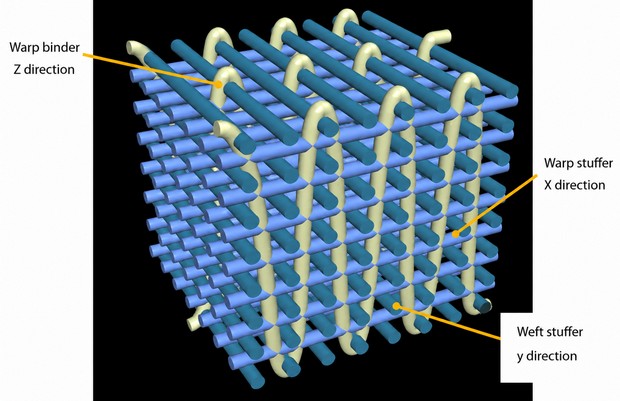
Whereas interlaced 3D fabric weaving involves only two sets of yarns, a non-interlaced 3D fabric requires three sets of yarns. These are multilayer warp (Z direction), weft (X direction), and a binder warp (Y direction). The loom’s shedding operation requires only one heddle, or heald frame, which is used to lay in the binder warps in the Z direction to firmly hold the multiple layers of the other yarns and thereby form the fabric thickness. This process of weaving 3D fabrics is referred to as noobing, that is, non-interlacing, orientating, orthogonally, and binding, which are the key features of both the process and the fabric.
3D Weaving of 3D Fabrics
As stated above, these are specially constructed looms that can produce directly woven, complex, shaped 3D fabrics of substantial thickness. The designs of such looms are not publicly available, but certain basic features are described in accessible patents. These patented processes are referred to as true 3D weaving because the weaving actions enable interlacement of three orthogonal sets of yarn: a set of multilayer warp (Z) and two sets of weft (X and Y), referred to as the horizontal and vertical wefts, respectively. To achieve this form of interlacing requires dual-directional shedding of the multi-layer warp (Z), that is, a shedding operation in the fabric thickness direction as well as in the fabric-width direction, forming multiple column-wise and row-wise sheds. This dual-directional shedding occurs sequentially and not simultaneously. The two orthogonal sets of weft are then alternately inserted in the mutually perpendicular multiple sheds. Since each weft is interlaced around a warp yarn, the warp yarns remain straight.
Conclusion
Multi-ply fabrics begin with layered cloth stitched by the double cloth principle, and they extend from treble cloth to higher ply structures. The same weaving cycle still underpins the process, but extra warp layers, filling insertions, and binder yarns create the thickness needed for 3D fabrics. Interlaced, non-interlaced, and fully interlaced forms each serve a different structural purpose, while shaped 3D fabrics need specially built looms. As weaving keeps moving toward more controlled three-dimensional structures, these fabric systems will remain important in advanced fibre reinforced composites and structural textile design.