However, technical textiles have emerged as one of the most influential stories about material in manufacturing around the world. The technical textiles are not the clothes you would see hanging on a shop shelf; they are functional substrates designed for their unique purpose like preventing a thermal explosion of a battery pack, securing the highway embankment, or maintaining the surgeon’s gown impervious to liquid penetration. Industry numbers confirm the trend: the technical textile fabric market was estimated at around $188.6 billion in 2025 and will be worth up to $355.8 billion by 2034 with 7.2% compound annual growth rate as per a research report released recently by DataIntelo. For procurement leads, product engineers, and investors watching adjacent materials categories, that trajectory is worth unpacking in some detail.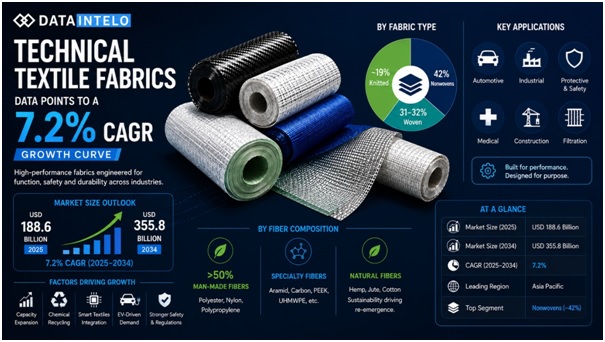
Sizing the Opportunity
An almost doubling of the value of an industry within ten years is not an accident, but rather a result of the confluence of several factors including the trend towards electrification of vehicles, aging population, strict safety policies in the workplace, as well as the construction industry that is pressured to increase its pace of building greener and better. Nonwovens, which are manufactured using spunbonding, meltblowing, needle punching, and hydroentanglement techniques, make up the biggest market share, accounting for approximately 42% of the total value due to their high adjustability regarding thickness, porosity, and fiber alignment. Woven fabrics occupy about 31–32% of the market, mainly used for industrial filters, conveyors, and aerospace reinforcement. Knitted fabrics are valued for their elasticity and represent approximately 19% of the market, especially thanks to compression garments and athletic wear.
As far as the composition is concerned, man-made fibers such as polyester, nylon 6/66, and polypropylene remain in control, occupying over half of the fiber value owing to their resistance properties and workability. Nonetheless, there is a revival of natural fibers like hemp, jute, and cotton fiber blends, due to concerns of sustainability, but specialty fibers like aramid, PEEK, carbon fiber, and ultra-high molecular weight polyethylene occupy the least share but register rapid growth.
Recent Factors Influencing the Technical Fabrics Industry
There are certain factors that have been converging over the past 18-24 months to change the manner in which technical fabrics are being sourced and specified:
Non-woven capacity investment
Manufacturers like Freudenberg Group, Berry Global and DuPont are investing heavily in spunbond and meltblown plants in Asia Pacific and Europe, with total investments in capacities between 1.2-1.8 million metric tons projected by 2030. Improved line speed and basis weight control have led to cost reductions of 8-12% per kg, which has resulted in new price-sensitive opportunities for filtration and construction that had been previously occupied by less expensive materials.
Chemical recycling reaching commercial scale
Companies such as Renewcell and Ioncell have moved fiber-to-fiber regeneration technology out of the pilot stage, with polyester recovery rates now exceeding 85–90% in some processes. That matters because the European Union’s Circular Economy Action Plan mandates a 30% cut in textile waste by 2030 and imposes extended producer responsibility on manufacturers pressure that is pushing recycled-content fabrics from a marketing footnote into a procurement requirement.
Smart textile integration moving from lab to line
There are trials underway for embedded sensors, conductive yarns, and graphene-infused fibers in applications ranging from soldier health monitoring, airframe integrity monitoring, and sports biometrics. This is a relatively nascent sub-sector, valued at around $2.3 billion in 2025, although its growth is at a near double rate compared to the rest of the technical fabrics sector, and it’s the one that is likely to receive the bulk of venture and R&D funding in the coming five years.
EV-driven specification changes
In line with battery platform scaling, the automotive industry is increasingly using nonwovens to replace traditional felt and foam for thermal barrier and acoustic dampening. The current estimate is that vehicles contain about 8 to 15 kg of technical fabrics, and electric platforms require the upper range due to battery pack insulation and vibration isolation requirements.
What’s Actually Driving the Growth Curve
Automotive Lightweighting and Electrification
The targets set for fuel economy and CO2 emissions – specifically the European Union’s 55 grams-per-kilometer cap on CO2 emissions and the US CAFE target aiming at 54.5 miles per gallon of fuel – are compelling car manufacturers to shave every ounce of weight off every component they use. Glass fiber- and aramid-reinforced technical fabrics are replacing heavier components such as steel and plastic, which are used in making doors, underbody panels, and bumper systems, without compromising safety. Adoption of electric vehicles is expected to grow to about 35 percent of global passenger-car sales by 2034, according to the International Energy Agency, and that brings an additional demand – battery housing requires temperature-specific thermal barriers which can retain their properties from -20 to 60 degrees Celsius.
Healthcare Consumption That Never Fully Receded
Although the use of face masks and surgical drapes is not at their pandemic-era peaks, there has been a structural increase in the levels of use for the former. According to estimates, annual global face mask consumption amounts to 180 to 220 billion pieces – compared to the period before 2020, when this number was much lower. With populations of North America and Europe aging, the proportion of people aged 65 years or older being 17 to 22% of the overall population, the tailwinds will persist in the orthopedics and wound care markets, apart from PPEs. The growth of demand for medical non-wovens is around 6.8 to 7.1% per annum – AAMI PB70, EN 13795 provide fluid barrier and biocompatibility benchmarks, among others.
Regulatory Mandates on Protective Equipment
Safety at the workplace has been seen as one of the least exciting and yet most dependable areas to grow in this sector. This is because the fire retardancy requirements set by OSHA, arc flash requirements by NFPA 70E, and ISO 11611 for welding have almost made the use of some fabrics mandatory for the industries such as petrochemical, utilities, and heavy industries. These requirements are growing at a compounded rate of 6.3% per year.
Construction and Infrastructure Modernization
Global construction spend, north of $18 trillion a year, increasingly leans on geotextiles for soil stabilization, waterproofing membranes, and insulation facing. The EU’s Renovation Wave initiative — targeting energy retrofits across 35 million buildings by 2030 — and India’s National Infrastructure Pipeline, representing roughly $1.4 trillion in planned transport and energy investment, are two of the larger structural drivers behind a construction-linked growth rate approaching 7.8 to 8.2%, the fastest of the major application categories.
Regulatory Context Senior Buyers Should Track
In the current context, regulation is playing a dual role – both demand driver and a cost factor. On the one hand, regulations for safety and emissions are acting as a catalyst for the adoption of newer fabrics in procurement across automobiles, industrial and medical sectors. On the other hand, regulations in environmental policy are beginning to put limits on the synthetics which are dominant players in this category. In various EU member countries, the issues related to micro plastic shedding are forcing regulators to examine the use of non-treated polyester and polypropylene non-woven products, and at the same time the regulations of extended producer responsibilities are passing the end-of-life costs back to the producers.
Regional Read
Asia Pacific holds the largest share of activity, close to 38%, powered by Chinese non-woven manufacturing scale over 40% of global capacity sits there alongside India’s pharmaceutical export growth and highway and rail infrastructure build-out. Europe follows at roughly 28–29%, propelled by automotive emissions compliance and a genuinely deep bench of specialty polymer producers (BASF, Lanxess) feeding fiber innovation. North America, at around 18%, leans on aerospace composite demand from Boeing and Lockheed Martin-scale programs and a steady renovation cycle in residential and commercial construction. Latin America and the Middle East & Africa together make up the remaining 15%, with growth increasingly tied to local manufacturing capacity that reduces import dependence rather than pure consumption growth.
Emerging Technologies Worth Watching
- Bio-based fiber development —mycelium-derived leather alternatives, lab-grown silk proteins, and cellulose nanofibril composites are being engineered to match, not just approximate, the performance specs of petroleum-based fibers.
- Fiber-to-fiber chemical recycling — depolymerization technology is starting to make “closed loop” polyester a realistic procurement category rather than an aspiration.
- Sensor-embedded fabrics — conductive pathways and flexible electronics are converging with textile manufacturing in ways that could eventually blur the line between “fabric” and “device,” particularly in defense, sports performance, and rehabilitation medicine.
- Automated non-woven line scaling — high-speed spunbond lines now running at 500 to 900 meters per minute are compressing the cost gap between commodity and technical-grade non-wovens, which should widen the pool of applications that can justify switching.
A Practical Case in Point
The best example that shows how all these elements work together is inside the engine of an electric vehicle. Currently, one of the most popular models of the electric car includes approximately 12-14 kg of technical fabric non-woven thermal insulation covering the battery, needle-punched acoustic materials used in the floor and walls, and non-woven reinforced composites in doors. That fabric package does three jobs simultaneously: it protects the battery from thermal extremes, it dampens cabin noise by an estimated 3 to 5 decibels versus an unoptimized design, and it contributes to a 3 to 5% fuel-or-range efficiency gain by shaving mass elsewhere in the vehicle. It’s a small, largely invisible component category, but it’s become load-bearing literally and figuratively for how automakers hit their weight and range targets. That’s a useful proxy for how technical fabrics function across the broader economy: unglamorous, embedded, and increasingly non-negotiable.
Where the Opportunities Sit for the Rest of the Decade
For manufacturers and buyers positioning for the next several years, three areas stand out. First, recycled and bio-based fiber capacity is likely to shift from a compliance cost to a competitive differentiator, particularly for suppliers selling into the EU and into OEMs with public carbon commitments. Second, smart-textile applications while still a small fraction of total value are growing fast enough that early supplier relationships in sensor-integrated fabrics could pay off disproportionately for buyers in defense, healthcare, and sports-performance categories. Third, non-woven capacity expansion in Asia Pacific is likely to keep compressing costs, which should pull technical-grade fabrics into cost-sensitive applications packaging, agriculture, entry-level construction that haven’t historically been able to justify the premium.
Closing Thought
The 7.2% growth curve behind technical textile fabrics isn’t the product of a single breakout application it’s the sum of several independent, regulation-anchored, and technology-driven demand streams running in parallel across automotive, healthcare, construction, and protective equipment. That breadth is exactly what makes the trajectory credible rather than speculative: no single sector’s slowdown would meaningfully derail it, and the regulatory tailwinds pushing adoption in each of those categories show no sign of reversing.
Author Bio
Ashish Kolte is a Marketing Manager at DataIntelo with expertise in marketing, market intelligence, and business strategy. He combines marketing insights with industry research to analyze market trends, identify growth opportunities, and provide data-driven perspectives on emerging industries and global business developments.
LinkedIn: https://www.linkedin.com/in/ashishkolte/