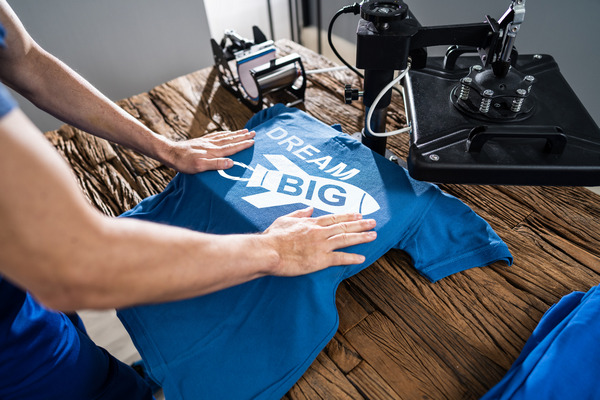
Heat transfer printing is used to apply patterns, graphics and decorative effects to textile products. Rather than printing directly onto fabric, the process begins with a design prepared on a separate carrier, such as transfer paper or film. Heat and pressure are then used to transfer the intended image or decorative layer onto the textile surface.
The complete production process involves more than the final heat press. Carrier materials, printing methods, ink compatibility, fabric composition and transfer conditions all influence the finished result. Understanding these stages helps textile producers identify quality problems and select appropriate production methods.
What Is Heat Transfer Printing in Textiles?
Heat transfer printing is a textile decoration process in which a prepared design is transferred from a temporary carrier to fabric under controlled conditions. Depending on the transfer system, heat may cause dyes to migrate into compatible fibers or activate an adhesive that bonds a printed layer to the fabric.
Two important methods are dye sublimation transfer and film-based transfer printing. Sublimation typically uses specially formulated dyes that transfer into suitable polyester materials. Film-based systems may use printed ink layers, release coatings and adhesives to create designs on compatible textiles.
These methods should not be treated as interchangeable. Their printing materials, transfer conditions, fabric requirements and final surface characteristics can differ significantly.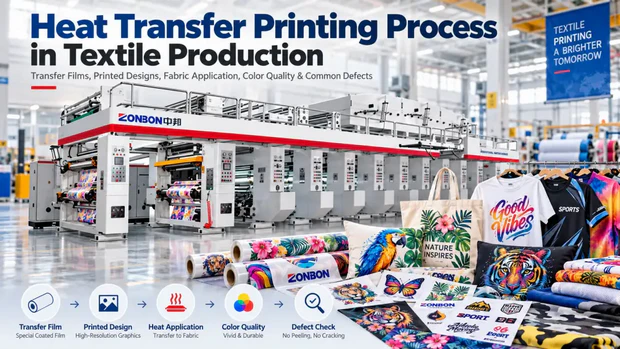
Transfer Films, Papers and Inks
The carrier material temporarily holds the printed design before transfer. Its surface properties, dimensional stability and compatibility with the ink system are important for accurate image reproduction.
Transfer paper is commonly associated with sublimation printing, while PET films are used in certain film-based textile decoration systems. Some applications also require release coatings, adhesive layers or other specially formulated materials.
| Material | Main Function | Typical Considerations |
|---|---|---|
| Transfer Paper | Carrier for suitable transfer inks | Ink absorption, release behavior and dimensional stability |
| PET Transfer Film | Carrier for compatible printed transfer layers | Surface treatment, coating compatibility and release performance |
| Transfer Inks | Provide color and printed detail | Color reproduction, transfer mechanism and fabric compatibility |
| Adhesive Layers | Bond certain transferred designs to fabric | Bonding strength, flexibility and washing resistance |
Selecting these materials as a compatible system is more important than evaluating each component separately. An unsuitable combination can lead to incomplete transfer, poor adhesion or inconsistent color.
Preparing and Printing Transfer Designs
The production process begins with artwork preparation. Design files are checked for dimensions, resolution, color requirements and image orientation. Depending on the transfer method, the artwork may need to be mirrored before printing.
The next stage is transferring the design onto the selected paper or film. Digital printing is widely used for customized graphics and short production runs. Other industrial printing methods are suitable for particular transfer materials produced in continuous rolls.
For example, heat transfer rotogravure printing is one approach used to reproduce detailed patterns on compatible carrier films. This process uses engraved cylinders to transfer ink onto a moving substrate and is particularly relevant to repeat-pattern production.
After printing, the design may pass through drying, curing or additional coating stages, depending on the ink and transfer system. Before further processing, producers should inspect color consistency, printed detail, surface defects and registration accuracy.
At this stage, the design exists on the carrier material. Its successful application to fabric still depends on the subsequent transfer process.
Transferring Designs onto Fabric
Once the printed carrier is ready, the transfer stage applies the design to the textile. Temperature, pressure, contact time and fabric properties must be matched to the particular transfer technology.
- Check fabric compatibility: Confirm that the fiber composition and surface characteristics are suitable for the selected transfer system.
- Prepare the fabric: Remove unwanted moisture, contamination or wrinkles that could affect contact with the carrier.
- Position the design: Align the printed material accurately to prevent incorrect placement.
- Apply heat and pressure: Follow validated settings for the ink, adhesive, carrier and textile combination.
- Remove the carrier: Use the specified hot, warm or cold peeling procedure when required.
- Inspect the result: Check image completeness, color appearance, surface texture and adhesion.
There is no universal temperature or pressing time suitable for every transfer material. Polyester sublimation printing and adhesive-based film transfers operate through different mechanisms and therefore require different settings.
For reliable production, settings should be established through material supplier recommendations and practical testing rather than general assumptions.
Color Registration and Print Consistency
Color consistency is important when the same textile pattern must be reproduced across multiple production batches. Variations may originate during artwork preparation, carrier printing, transfer application or subsequent fabric processing.
In multicolor carrier printing, registration refers to the alignment of individual printed colors. Poor registration may create unwanted outlines, overlapping elements or distorted pattern details.
During the roll-to-roll printing of transfer films, web tension, substrate stability, drying conditions and printing alignment can influence the repeatability of the printed design.
However, accurate printing on the transfer carrier does not automatically guarantee an acceptable textile result. Fabric composition, heat distribution, transfer pressure and material compatibility can still change the final appearance.
A practical quality-control approach therefore checks both stages separately: the printed carrier before transfer and the decorated fabric afterward. Keeping approved samples and recording process settings can also help identify the source of production variations.
Common Heat Transfer Printing Problems
Heat transfer printing defects can result from the carrier, printing process, fabric or transfer conditions. Identifying the stage where a defect first appears is often the fastest way to determine the likely cause.
| Problem | Possible Cause | Recommended Check |
|---|---|---|
| Faded Colors | Ink incompatibility or unsuitable transfer conditions | Verify materials and approved transfer settings |
| Blurred Designs | Carrier movement or uneven contact | Check positioning, pressure and handling |
| Incomplete Transfer | Insufficient heat, contact or incompatible materials | Inspect temperature distribution and material compatibility |
| Color Misregistration | Misalignment during multicolor carrier printing | Inspect printed carrier registration |
| Poor Wash Durability | Unsuitable bonding or transfer system | Conduct appropriate laundering and adhesion tests |
For example, if a color alignment defect is already visible on the transfer film, changing the heat press settings is unlikely to solve its original cause. Conversely, a correctly printed carrier may still produce poor results when fabric compatibility or heat distribution is unsuitable.
Separating upstream printing defects from downstream transfer defects helps reduce unnecessary adjustments, rejected materials and repeated production trials.
Choosing the Right Process for Different Fabrics
The most suitable heat transfer process depends on the textile material, design requirements and expected product performance. Fiber composition is a primary consideration because different transfer systems interact with fabrics in different ways.
Dye sublimation is generally associated with polyester or suitably coated substrates. Cotton and blended fabrics may require alternative transfer systems, depending on the desired appearance and durability.
Other considerations include design complexity, production quantity, surface feel, stretch requirements, washing resistance and the intended end use. A decorative graphic on a fashion accessory may have different performance requirements from a design applied to frequently washed sportswear.
Before large-scale production, textile processors should test representative fabric samples and evaluate visual quality, adhesion, flexibility and relevant durability requirements. A process that performs well on one fabric construction may not produce identical results on another.
Conclusion
Heat transfer printing combines several connected operations, from preparing the original design and printing a suitable carrier to applying the image onto fabric. Each stage influences the appearance and performance of the finished textile.
By understanding carrier materials, printing accuracy, fabric compatibility and transfer conditions, textile producers can make better process decisions and identify defects more efficiently. Consistent results depend on treating the printing and transfer stages as parts of one carefully controlled production workflow.