When wool, silk, and speciality hair fibres are dyed for fabrics and garments, the fibre structure has a direct effect on shade depth, levelness, and wash durability. Protein fibres behave differently from other textile fibres because their amino, carboxyl, and side-chain groups can take part in dyeing. Wool is the main animal fleece fibre in this group, but silk and several speciality animal hair fibres are also important in practice. The choice of dye is therefore closely linked to the fibre type, the bath conditions, and the end use of the material.
Protein Fibres and Their Structure
Proteins are natural polymers of high relative molecular mass formed by condensation of α-amino acids through their carboxyl and amino groups. They are widespread in nature and form essential components of animal and plant tissue. The α-amino acids have the general formula and are distinguished from one another by the R-group, which can be basic, acidic, or non-polar. Examples include the amino acids proline and cystine.
Each protein chain contains a primary amine group at one end of the chain and a carboxylic acid group at the other end. Wool belongs to a class of proteins known as keratins. Cystine plays a key role in the properties of wool, but it is absent from the structure of silk. Basic and acidic side chains occur much less frequently along the silk fibroin peptide chains, and electrostatic links between them make a much smaller contribution to the internal structure of the fibre.
Wool is by far the most important of the animal fleece fibres in the protein fibre category, but several others are also of interest. These include mohair and cashmere from species of goat, alpaca and vicuna from camel species, angora fur from rabbits, wool from the llama that is native to the Andean plateau, and yak hair from the humped Tibetan ox. Most of these speciality fibres, notably cashmere, angora, and mohair, are relatively scarce and costly, but they may be blended with high-quality wool to increase lustre and give a distinctive appearance. Demand for such blends is largely subject to the dictates of fashion.
Dyes Used for Protein Fibres
The dyes used for dyeing protein fibers include acid dyes, chrome dyes, metal-complex dyes, and reactive dyes. Each class behaves differently on wool, silk, and hair fibres, so the dyeing method has to match the fibre very closely.
Acid Dyes
Acid dyes are anionic and will dye any fibre that contains positively charged ions. Such dyes are used for dyeing wool, silk, and polyamide. They ionise in solution to form sodium ions and large negatively charged coloured ions. Wool contains more potential dye sites than polyamide and, as a result, it is possible to achieve deeper shades.
Acid dyes for wool may be classified into a number of distinct groups. Traditionally, they were mainly of two types: acid-levelling dyes and acid-milling dyes. Acid-levelling dyes have a relatively low affinity for wool under neutral conditions, whereas under acid conditions the tendency is to give unlevel dyeing due to the high rate of strike. In practice, it is common to dye in the presence of an acid such as sulphuric acid, which increases the affinity of the dye for the fibre, plus sodium sulphate, also known as Glauber’s salt, which slows down the rate of dyeing. Acid-levelling dyes tend to have poor durability to washing and alkaline treatments, yet they are often preferred for their good levelling character.
Acid-milling types produce better wash durability. The classification into acid-levelling and acid-milling types is not sharply defined, and a method based on dye-bath acidity is often used. Acid-milling types possess higher affinity for wool and are therefore applied from a much weaker acid bath, for example, using ammonium sulphate or acetate. A typical dyeing method is similar to that used for levelling types, but the acid is replaced and Glauber’s salt is omitted.
Chrome Dyes
Chrome dyes are less popular today largely because of health and environmental constraints. They may be considered as acid dyes that contain groups capable of forming a stable complex with chromium. There are three main methods of application on wool: chrome mordant, after-chrome, or top-chrome, and meta-chrome. Chromium remains a problem for the dyer, particularly as discharge limits become tighter. Even with strict effluent control and optimised dyeing methods, the future for chrome dyes may be questionable.
Chrome Mordant Method
This is the oldest technique, though not the most important. It involves mordanting the wool using 2% to 4% potassium dichromate, the bath being made up at around 50°C with a small amount of acid. The wool is then added, the temperature is raised to the boil, and the process is continued for 1 to 1.5 h. After pre-mordanting, the fabric is dyed in the manner described previously.
After-Chrome Process
The wool is first dyed with dye plus around 10% Glauber’s salt for 1 h at the boil. Any dye remaining in the bath is then exhausted with the addition of acetic acid. Then 1% to 2% potassium dichromate is added and the process is continued for 30 min. For deep shades, such as black, it is common to add an acid such as sulphuric acid. Varying the concentration of the acid gives different depths of black.
Meta-Chrome Method
Certain chrome dyes can be dyed and mordanted simultaneously in the same bath, but it is very important that the dyeing takes place well under neutral conditions, the dye is not affected by salt in the bath, and the dichromate or chromate present in the bath is reduced on the fibre. Otherwise, the dye will be precipitated.
In this method, the metachrome mordant is first produced, probably comprising one part sodium chromate to two parts ammonium sulphate. The dye bath is set at around 50°C with water, dye, and 2% to 8% of the metachrome mordant. Dyeing takes place in the usual manner. The level of the mordant will vary depending on the desired shade.
Metal-Complex Dyes for Wool
Metal-complex dyes consist of an acid dye type structure in a complex with a metal ion. In addition to natural fibres such as wool and silk, they can be applied to polyamide. Two key categories exist: 2:1 metal-complex dyes, which consist of two parts dye to one part metal, and 1:1 metal-complex dyes, which consist of one part dye to one part metal. The 2:1 metal-complex dyes are neutral dyeing, mainly complexes of chromium with water-soluble azo dyes, while 1:1 metal-complex dyes are seldom used on polyamide and are mainly used on wool.
On wool, 1:1 metal-complex dyes are applied from a low-pH dye bath, around pH 2, using up to 8% sulphuric acid. As dyeing is carried out at the boil at low pH, care must be taken because of the possibility of damage to the wool. Under such conditions, there may also be noticeable shade changes in the dyes.
Reactive Dyes for Wool
Reactive dyes are dyes that form a covalent bond with the fibre, so their durability, particularly to washing, is generally good. Reaction takes place on wool, as on cotton, with hydroxyl groups present in the fibre. However, on wool, both thiol and amino groups are also available for bonding with the dye.
The application of reactive dyes on wool requires the addition of auxiliaries to prevent skitter and grossly unlevel dyeing. Such auxiliaries include surface-active agents that are capable of forming dye-surfactant complexes, which aid the dyeing operation.
Dyeing of Silk
The dyeing behaviour of silk is similar to that of wool, but silk typically requires between two and four times as much dye as wool to achieve a similar visual depth because of the fineness of the silk filament. Acid-milling, 2:1 metal-complex, and direct and reactive dyes are the most important classes for silk dyeing.
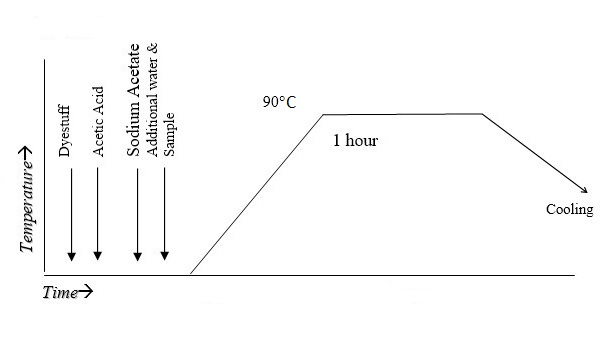
Traditionally, the concentrated soap solution remaining after degumming was used to provide an anionic levelling system for the application of direct and acid dyes. This approach has been superseded by dyeing with 2:1 metal-complex and acid-milling dyes in the presence of levelling and penetrating agents. Typically, dyeing is commenced at 30°C in the presence of 1% to 2% of a weakly cationic levelling agent at pH 4.5 to 5.0. The temperature is raised at 1°C per minute to a top temperature in the range 70°C to 85°C, depending on dye exhaustion and the type of equipment available. Dyeing is continued for 45 to 60 min at top temperature before cooling and rinsing.
Dyeing of Hair Fibres
Other than wool fibre, animal hair fibres are protein fibres in nature, and all dyes used for dyeing wool fibre can be used for dyeing animal hair fibres. However, the properties of animal hair fibre should be considered before undertaking the dyeing process. For example, angora is only processed in blends with wool, sometimes with the addition of a small proportion of nylon to improve durability. For economic and technical reasons, 2:1 metal-complex and acid-milling dyes are preferred.
Chrome dyes and 1:1 metal-complex types are seldom used because strongly acidic dye baths may damage the angora. Major outlets for wool and mohair blends are worsted outerwear and fabrics for suiting. Such fabrics may be made from intimate blends for both warp and weft, but they often consist of a mohair warp with a botany wool weft. Wool and mohair fabrics may be piece-dyed with 2:1 metal-complex dyes or more economically with levelling-acid dyes.
Conclusion
Protein fibres present a wide range of dyeing behaviour, even though wool, silk, and animal hair fibres share the same broad protein basis. Acid, chrome, metal-complex, and reactive dyes each have a clear place in protein fibre dyeing, depending on the fibre and the shade required. Wool accepts the widest range of methods, while silk usually needs higher dye usage because of its finer structure. Animal hair fibres follow the same general rules, but their own fibre properties must always be kept in mind. As fibre blends and fashion demands keep changing, these dyeing choices will remain important in practice.